What Actually Sets Your Minimum Order.
Most buyers meet a minimum order they did not expect and assume the factory is being difficult. It usually is not. Six separate things stack up to produce that number, and usually one of them is doing most of the binding — find it and you can move it, though the constraints can interact. Small-batch production is possible more often than buyers expect: in some product categories a first run from around 3,000 units is workable. Which categories those are differs product by product, so ask us and we will tell you where yours sits.
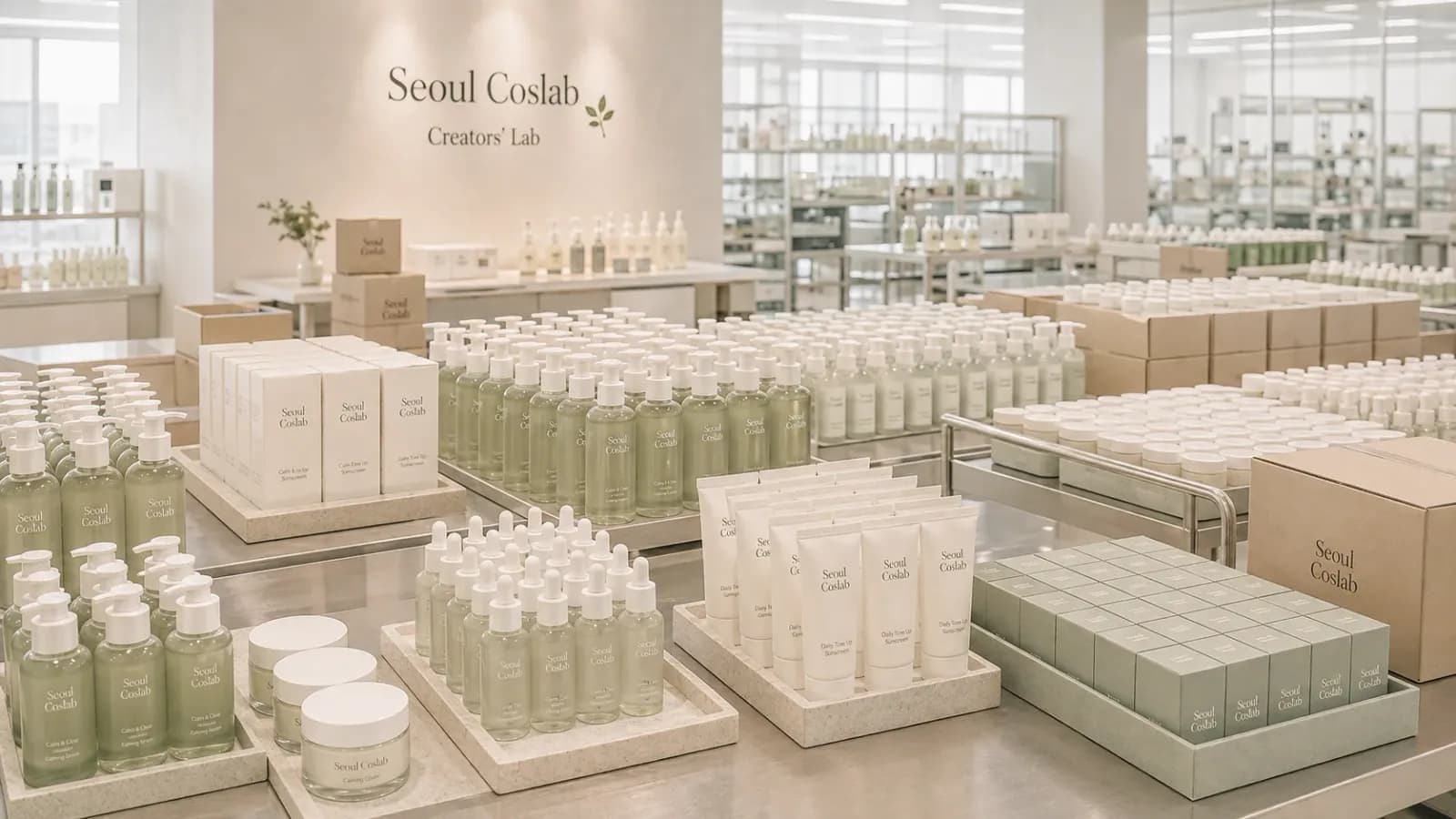
A minimum order is not one number.
- 01
Bulk batch size
The mixing vessel has a floor below which the formula will not emulsify or disperse correctly. This is physics, not policy, and it differs by formula type.
- 02
Container minimum
Stock bottles ship from inventory. Custom shapes need tooling, and tooling needs enough volume to justify cutting it. This is usually the highest number in the stack.
- 03
Closure and components
Pumps, droppers and caps carry their own supplier minimums, set independently of the container. A custom cap on a stock bottle still raises the floor.
- 04
Decoration
Silkscreen and hot stamping have setup costs per colour. Label printing has a minimum run length. Both push the number up in steps rather than smoothly.
- 05
Line changeover
Cleaning and reconfiguring a filling line takes hours whether the run is small or large. Below a certain volume the changeover costs more than the run earns.
- 06
Testing and documentation
Stability, challenge testing and market documentation cost the same for a small run as a large one. They are fixed costs looking for units to spread across.
Asking a factory to go lower rarely works. Changing the binding constraint does.
- 01
Use stock packaging
In our experience the largest single reduction available. Differentiate through decoration and artwork rather than through the shape of the bottle.
- 02
Start from a formula that already exists
Developing from nothing means a vessel sized to that formula, a full testing programme and the documentation a new formula brings with it. Customising a base that already exists inherits part of that, and some base systems run in smaller vessels than others.
- 03
Put your volume behind fewer SKUs
Four products are four bulk batches, four component sets and four changeovers, each clearing its own floor alone. The same budget behind two puts twice the volume behind each.
- 04
Split one bulk batch across SKUs
Two fill sizes, or two variants sharing a base, can clear a bulk minimum that a single SKU cannot reach on its own.
- 05
Simplify decoration
Fewer print colours and a single decoration method cut setup cost and often remove a step from the critical path.
- 06
Build the range around one raw-material family
Raw materials carry supplier minimums of their own. Where several products draw on the same active and base system, that material is bought once, qualified once and documented once.
- 07
Let the calendar move
Reconfiguring a line takes the same hours whether the run is small or large, so a manufacturer filling a gap works with different arithmetic. Ordering earlier, accepting a production window, or committing in phases with an agreed follow-on all buy the same thing.
Before you ask
What we need to quote a real number.
MOQ depends on the formula, packaging format and component minimums. We quote per project.
We do not publish one figure for every project because a figure without these inputs is not information — it is a number you would have to unlearn later. With them, we can be specific.
- 01Product category and format — serum, cream, sheet mask, stick
- 02A benchmark product, or a clear description of the texture and finish you want
- 03Destination market, because it changes testing and documentation
- 04Whether packaging is stock, custom, or undecided
- 05The volume you can commit to, and whether a follow-on run is realistic
- 06Your launch window, and how firm it is
Frequently Asked Questions
What is MOQ in cosmetics manufacturing?
Minimum order quantity is the smallest run a manufacturer will produce. It is not one number but the most restrictive combination of six stacked minimums — bulk batch, container, closure, decoration, line changeover, and testing and documentation. Usually one of them binds hardest, and which one it is depends on your project.
What is the minimum order quantity in Korea?
There is no single figure to publish, which is why we quote per project: the same category can differ several-fold depending on the packaging route alone, so one number posted for everyone would be wrong for almost everyone reading it. What we can say before any of that is that small-batch production is possible — in some product categories a first run from around 3,000 units is workable. Which categories, and where your own product lands, is settled in the conversation about your project rather than on a price list.
Why do cosmetic manufacturers have a minimum order at all?
Because several costs are fixed per run rather than per unit: vessel cleaning, line changeover, decoration setup, testing and documentation. Below a certain volume those costs exceed what the run generates, so the run is not offered.
What is the fastest way to lower my minimum order?
Move from custom to stock packaging. Custom tooling minimums frequently exceed the bulk formula minimum by a wide margin, which means the packaging decision — not the formula — is setting your number.
Does a smaller order mean a higher unit price?
Yes. Fixed costs spread across fewer units. The more useful question is whether the total commitment fits your cash position and your sell-through rate, not whether the unit price has reached its floor.
Can I test a market with a very small first run?
Sometimes. Private label with stock components has the lowest floor because there is no formulation cycle and no new tooling. A custom formula in custom packaging has the highest. Tell us the constraint you are working to and we will tell you what is reachable.
Discuss Your Target Quantity
Tell Us the Project.
We’ll Tell You the Number.
A category, a packaging direction and a target market are usually enough for a first answer.
Discuss Your Target Quantity →