Korean Cosmetic ODM Development and Manufacturing
ODM usually starts from a formula that already works. You adapt texture, actives, fragrance and packaging to your market instead of developing a base from nothing — which is why it reaches production faster than OEM and costs less to get wrong.
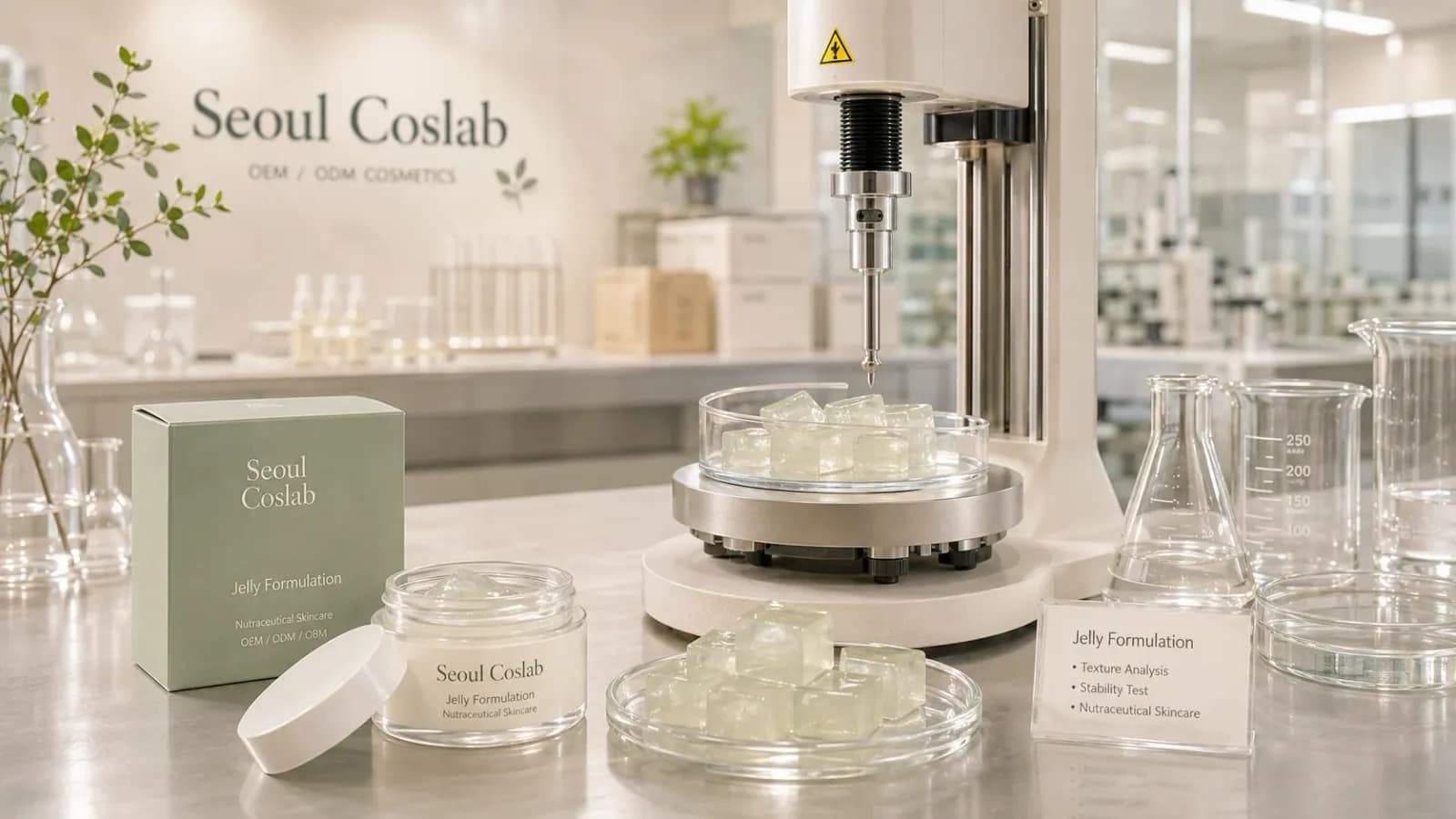
What it means
In the most common form of an ODM project the manufacturer owns a library of tested base formulas. You select a base that matches the product you have in mind, then modify it: viscosity, active concentration, fragrance, colour, claim direction, packaging.
How far the development goes differs between manufacturers, and so does what you hold at the end of it. Modifying a base the manufacturer already had normally leaves that base with the manufacturer; work that starts from your brief can end differently. What you get either way is speed and a shorter validation path, and what you own is settled in the agreement before development starts rather than implied by the model.
Who it is for
- 01Distributors and retailers launching a private range alongside the brands they already carry
- 02Established brands entering a new category where they have no formulation history
- 03E-commerce sellers who need a defensible product rather than a generic one
- 04Clinics and professional channels wanting a branded retail line
What we handle
Base selection
We shortlist bases across several Korean formulation houses against your target texture, price and claim direction — not against whichever factory we spoke to last.
Modification brief
Your changes are written as a specification the lab can act on, with acceptance criteria, so sampling rounds converge instead of circling.
Sampling
Iterations run until texture, scent, finish and stability match the brief. We track what changed between rounds so decisions are reversible.
Packaging fit
Container, closure and decoration are checked against the formula for compatibility before tooling is committed.
Testing and documentation
Stability, challenge and market-specific documentation are arranged to suit where the product will actually be sold.
Production and export
Bulk manufacture, filling, inspection against the agreed specification, then shipping documents and delivery.
Manufacturing through contracted Korean partners, matched to your product — every order made in Korea. Certifications depend on the selected manufacturing partner and project requirements.
Frequently Asked Questions
What is the difference between ODM and OEM in cosmetics?
ODM means the formulation work sits with the manufacturer — most often modifying a base it already has, sometimes developing against your brief. OEM starts from your formula or concept and produces it. ODM is faster and cheaper to validate; a classic OEM project gives you control over the specification, with formula rights defined in the agreement. Manufacturers draw the ODM line in different places, so the practical question is where your project starts from, and that is agreed at the outset.
Do I own the formula in an ODM project?
It depends on where the project starts and on what the agreement says, and manufacturers treat it differently. Where you modify a base the manufacturer already had, that base normally stays with the manufacturer, and your branding, packaging design and the specific modification set are yours. Where a formula is developed to your specification, ownership can be yours. Ownership, exclusivity and how long it lasts are three separate terms and we settle all three in writing before development starts. If the formula has to be yours from the outset, OEM is the cleaner route.
Can the same base be sold to a competitor?
Base formulas are generally non-exclusive unless exclusivity is negotiated, which usually raises the minimum volume. We flag where a base is widely used so you can decide whether that matters for your category.
How long does an ODM project take?
It depends on how far the modifications move from the base, how many sampling rounds are needed, and whether packaging requires new tooling. We give a timeline against your specific brief rather than a headline number.
Other routes to the same product.
Related services
Find the Right Manufacturing Solution
Let’s Create
What’s Next in Beauty.
Tell us the category, the market and roughly what volume you can commit to. We will come back with what is realistic.
Find the Right Manufacturing Solution →