Korean Cosmetic Formulation Development
Formulation is where most projects lose time, and in our experience the most common reason is a brief that was not specific enough to act on. A texture described as “light but rich” tends to add sampling rounds. A target viscosity range with a named benchmark gives the lab a measurable reference to converge on.
What it means
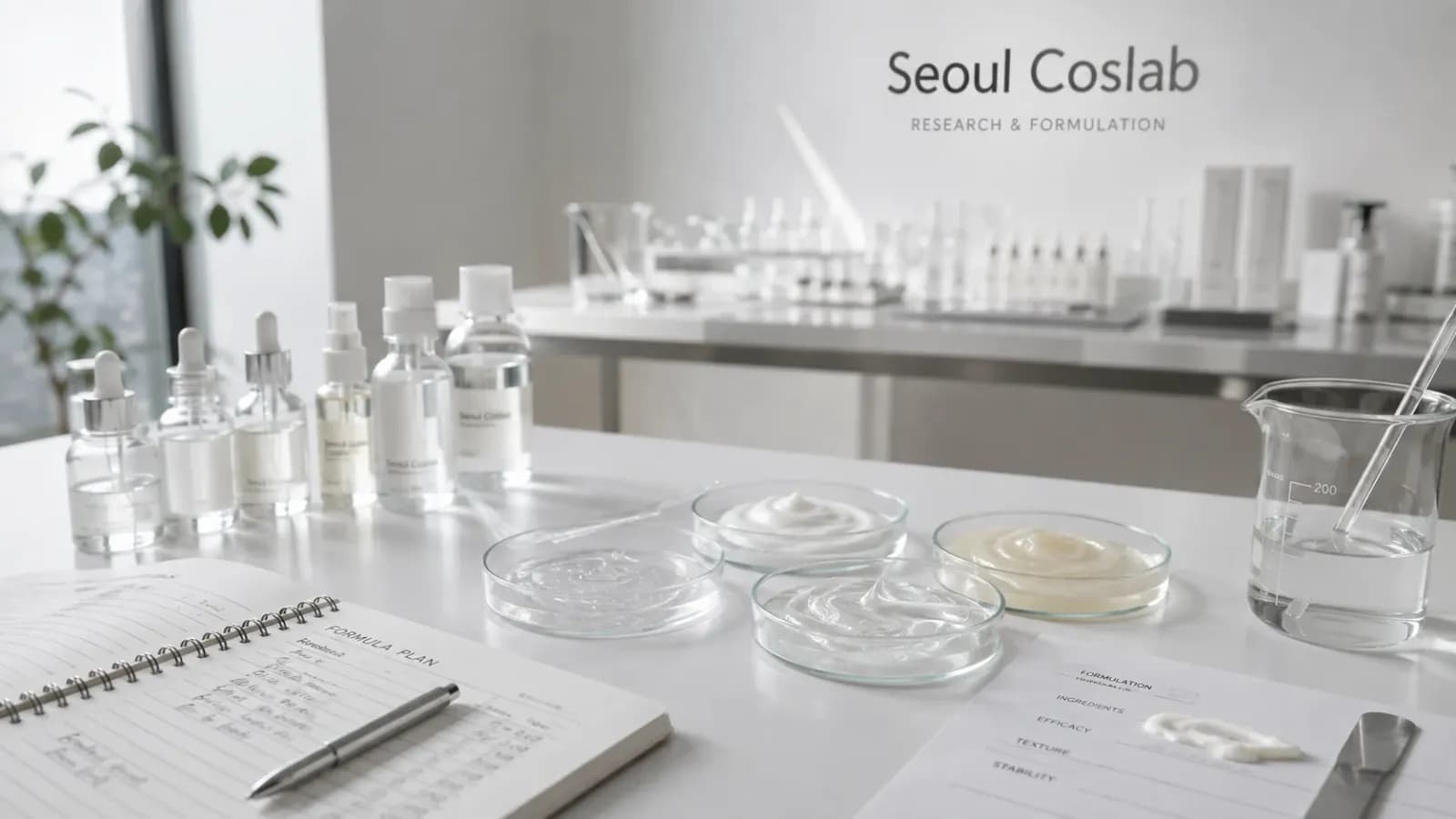
Formulation covers the base system, active selection and concentration, sensory profile, preservation, pH and the interactions between all of them. Changing one moves the others.
Korean formulation houses specialise narrowly. A lab that produces exceptional sunscreens is often not the lab you want for an anhydrous balm. Matching the brief to the right lab does more for the outcome than any number of sampling rounds.
Who it is for
- 01Brands who know the product experience they want but not how to specify it
- 02Companies with a benchmark product they want interpreted rather than copied
- 03Businesses whose sampling rounds keep circling without converging
- 04Brands needing a claim substantiated by the formula rather than by copywriting
What we handle
Brief to specification
Your description becomes a specification with measurable acceptance criteria, so a sample can be judged rather than debated.
Lab matching
Selected on demonstrated capability in your specific system — emulsion, anhydrous, gel, aqueous — not on general capability.
Active and claim direction
Concentration set against what the destination market permits you to say, so the claim and the formula are decided together.
Sensory development
Spreadability, absorption, after-feel, finish and fragrance developed against the benchmark.
Stability and compatibility
Behaviour over time and against the chosen packaging, tested before production is scheduled.
Manufacturing through contracted Korean partners, matched to your product — every order made in Korea. Certifications depend on the selected manufacturing partner and project requirements.
Frequently Asked Questions
How many sampling rounds should I expect?
It depends far more on brief quality than on the formula. In our experience, a specific brief with a benchmark and stated acceptance criteria typically converges in a few rounds, while a brief written in adjectives tends to take more.
Can you match a specific product I like?
We interpret it rather than copy it. Texture, finish and sensory profile can be targeted closely. Reproducing a competitor’s formula is neither legal nor useful, and the ingredient list on a package does not disclose enough to do it anyway.
What limits which actives I can use?
Regulation in your destination market, stability in the chosen base, compatibility with other actives, and packaging. Some combinations that look attractive on paper degrade quickly in a clear bottle.
Who owns the developed formula?
It depends on where the project starts and on what the agreement says — manufacturers treat it differently. A base the manufacturer already had normally stays with it; a formula built to your specification can be yours. Agree ownership, exclusivity and its duration in writing before development starts, not after.
Other routes to the same product.
Related services
Find the Right Manufacturing Solution
Let’s Create
What’s Next in Beauty.
Tell us the category, the market and roughly what volume you can commit to. We will come back with what is realistic.
Find the Right Manufacturing Solution →