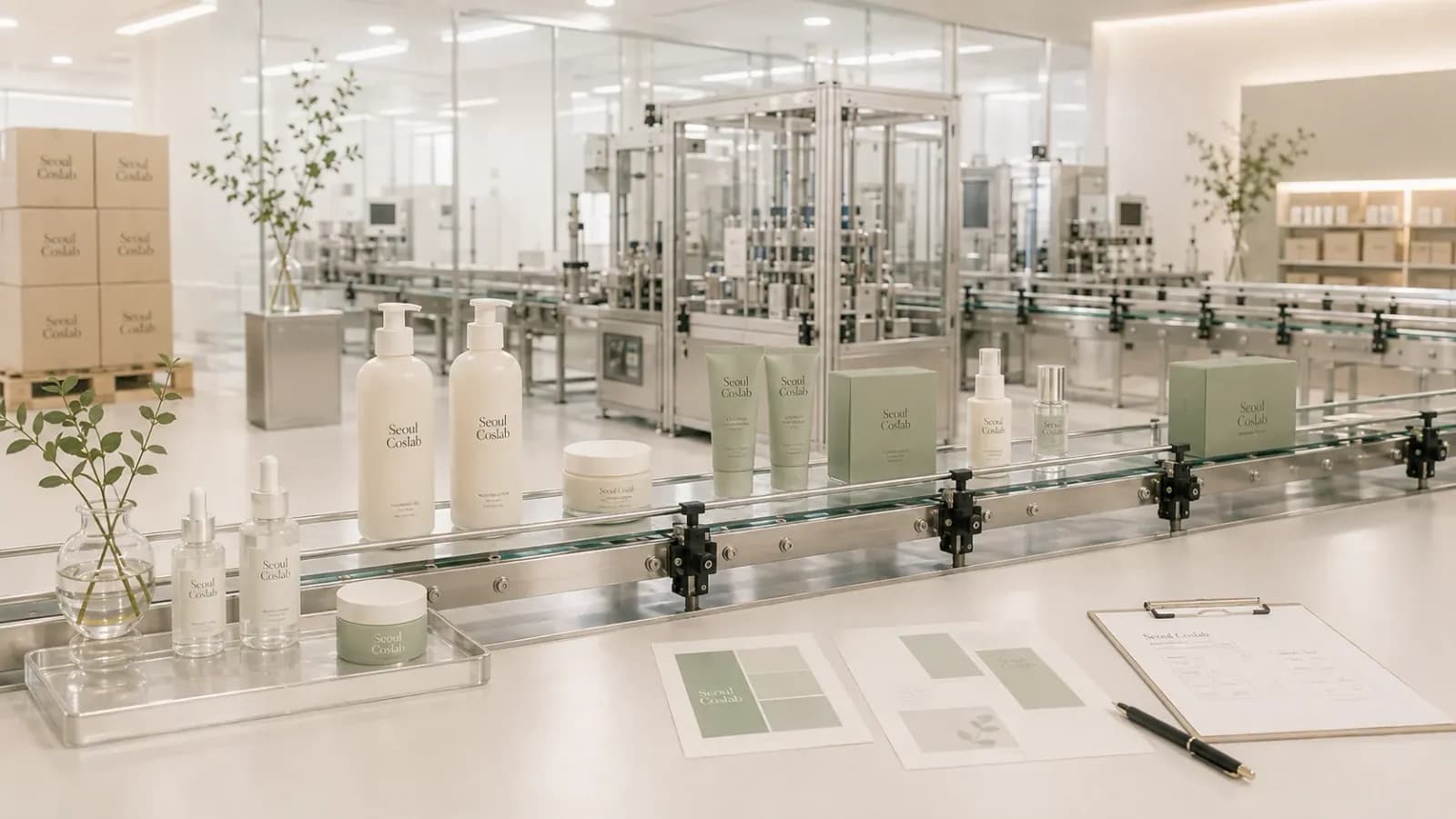
The reason to manufacture cosmetics in Korea is not the label on the bottle. It is that the industry here is split into specialists — formulation houses, packaging makers, filling lines and testing labs that each do one thing and do it for a living — and that separation is what makes development short. You are not buying access to one large factory that does everything adequately. You are buying access to a supply chain where every step has someone whose entire business is that step.
That distinction matters because it changes what you should be shopping for. Brands that come to Korea looking for a factory tend to find one, sign with it, and then discover that the thing they actually needed was a route through several suppliers who had never met. Brands that come looking for the ecosystem get the speed the ecosystem is known for.
What "Made in Korea" Actually Buys You
The label is worth something, and it is worth being precise about what.
In several markets — Southeast Asia, parts of the Middle East, and among a specific kind of consumer almost everywhere — Korean origin carries a real assumption of formulation competence. It opens a retail conversation faster than the same product made elsewhere. That is a marketing asset and you should use it.
What it does not do is any of the following. It does not clear your product for sale in your market: that is regulatory work you still have to do, and the requirements belong to the destination market rather than the country of manufacture. It does not make a mediocre formula sell. It does not shorten your own decision-making, which is where most launch calendars actually go wrong. And it does not protect you from choosing the wrong facility — the label is identical on a product from a manufacturer suited to your project and one from a manufacturer who took it because there was capacity.
So treat the origin as something you earn value from at the end, not a reason for the decision at the start. The reason for the decision is below.
The Industry Is Built Out of Specialists
Ask a Korean manufacturer what it makes and the good answer is narrow. One house has spent fifteen years on sun care and knows how a filter system behaves at scale. Another fills sheet masks and almost nothing else. A third is a formulation lab with no filling capacity at all, and a fourth does nothing but tubes.
This is not fragmentation. It is division of labour, and it exists because Korea's domestic market was large and competitive enough to support businesses that only do one thing. A packaging maker in Korea sells to hundreds of brands, so it can afford to hold moulds, run a component library, and develop new closures speculatively. A filling line that only fills ampoules gets very good at filling ampoules.
The consequence for you is that the capability you need almost certainly exists, and it almost certainly does not all sit in one building. Your product is assembled out of several specialists, and someone has to select them and hold the sequence together. That is a different job from manufacturing, and it is the subject of a separate article on why a manufacturing partner is not the same as a factory.
The Scale That Makes Specialisation Possible
Specialisation of this depth needs volume underneath it. Korea has it.
The Ministry of Food and Drug Safety reported US$11.4 billion in cosmetics exports for 2025, placing Korea second in the world by export value, shipping to 202 destination markets. The same release counts 32,570 registered manufacturers and brand owners — 4,158 manufacturers and 28,412 brand owners.
Read the last figure carefully, because it is the one that explains the structure. The manufacturers are outnumbered by brand owners roughly seven to one. Korea's industry is organised around a large population of brands that do not own factories, buying from a smaller population of factories that do not own brands. That arrangement is normal here in a way it is not everywhere, and it is why a first-time brand from abroad is not an unusual customer. The system was built for exactly that relationship.
Why Separation Shortens Development
Speed in cosmetics development is rarely about how fast any single step runs. It is about how many steps can run at the same time, and how quickly a step can be repeated when it fails.
Separation helps with both.
Iterations get cheaper. When the formulation lab is not the filling line, a texture revision does not compete for time with a production run. You can take a third and fourth sample round on a texture that is nearly right without pushing a factory's schedule around, which is why brands here often keep refining longer than they expected to and still launch on time.
Steps overlap. Packaging development, formula development and regulatory preparation are handled by different organisations, so they can be worked in parallel rather than queued. The full development sequence is set out on our process page, and most of its length comes from decisions rather than production.
Failure is contained. If a closure fails compatibility testing, you change component supplier. You do not change everything. In an integrated factory, a problem in one department is often a problem with the whole relationship.
What you give up is coordination. Five suppliers means five schedules, five quality standards, five sets of terms, and five ways for a message to be lost between a brand abroad and a plant in Gyeonggi-do. The speed is real, and it is only available to someone who can hold the pieces together.
What the Structure Looks Like From Your Side
Two brands can run the same product through the same ecosystem and have completely different experiences of it, and the difference is usually how many of the interfaces they are holding themselves.
If you already know which formulation house suits your product, which filling plant will take your volume, and which component maker holds the closure you want, the separation is pure benefit. You are buying each step from the specialist who does it best, and paying nothing for capability you do not need.
If you do not know those things, the same separation arrives as a series of questions you were not expecting to answer. Which of these facilities is right for an emulsion at my viscosity? Whose minimum binds first, the bulk or the bottle? Who is responsible when the pump turns out to be incompatible with a formula neither party made a mistake in? None of those questions is unanswerable. All of them take time, and they arrive in the middle of a project rather than at a convenient moment.
That is the honest shape of the trade. Korea's structure gives you depth and speed at the cost of coordination, and how good the trade is depends entirely on who is doing the coordinating.
What Korea Does Not Solve for You
An honest answer to "why Korea" has to include what the decision leaves untouched.
Your market's rules are still your market's rules. Manufacturing in Korea does not simplify a US facility registration and product listing obligation or an EU notification. Those attach to where you sell, and they need to be read at the start of development rather than at the end, because some of them change the formula.
Distance is real. You will not walk the line. Sample shipping adds days to every round, and time zones add a half-day to every question. Both are manageable and neither is free.
Cost is not automatically lower. Korea competes on formulation quality and development speed more than on unit price. A brand whose only requirement is the cheapest possible unit is usually better served elsewhere, and will be unhappy here.
Minimum order quantities still apply. They come from the same specialisation that gives you the speed: a component maker holds a mould for many customers and needs a run that justifies a changeover. What actually sets the number, and which lever moves it, is covered on our minimum order quantity page.
What This Means for Your Project
If you take one thing from this: choose Korea for the supply chain, not for the sticker, and plan the project as an assembly of specialists rather than a purchase from a factory.
Practically, that means three things at the start. Decide your destination market before your formula, because the market decides what the formula may contain and claim. Decide the product format early enough that packaging development can run alongside formulation rather than after it. And be clear-eyed about who is holding the sequence — if it is not you, it needs to be someone whose job that is.
The next question is usually which manufacturing model fits: whether you adapt a proven base, bring your own formula, or launch on a formula that already exists. That is the OEM, ODM and private label decision, and it is worth making deliberately.
Frequently Asked Questions
Is Korean manufacturing more expensive than manufacturing in China?
Usually yes on unit price, and the gap narrows as specification rises. Korea's advantage is in formulation depth, component variety and development speed rather than in the lowest possible cost per unit. If your product is undifferentiated and competes on price, that advantage is not worth paying for. If it competes on texture, finish or an active system that has to survive your market's regulations, it generally is.
Do I need to be in Korea, or have a Korean entity, to manufacture here?
No. Brands based abroad manufacture in Korea routinely, and the industry's structure — many more brand owners than manufacturers — assumes it. What you do need is a way to handle the parts that are hard to run remotely: facility selection, brief translation, sample rounds, and the export documentation your market asks for.
How long does it take to develop a product in Korea?
It depends on the route, and the honest version of that answer names the variables rather than hiding them: whether you start from an existing base or a new formula, whether your packaging is stock or custom, how many sample rounds you take, and what your destination market requires before launch. We break the clock down in our article on cosmetic manufacturing lead times.
Can I visit the factory that makes my product?
Yes, and brands do. Be aware that "the factory" is often several sites — a formulation lab, a filling plant and one or more component makers — so a useful visit is planned around which step you actually need to see.
Does manufacturing in Korea mean my product can be sold as K-beauty?
It can be marketed that way, and the origin claim is straightforward as long as the product is in fact made in Korea. The claims you make about what it does, however, are governed by your destination market and not by where it was filled. We look at how far those claims can go in our article on clean beauty claims.
- ’25년 화장품 무역수지 흑자 첫 100억 달러 돌파, 세계 2위 화장품 수출국 달성 — 식품의약품안전처 (Ministry of Food and Drug Safety, Republic of Korea)
This page is general information for manufacturing planning. It is not legal or regulatory advice, it has no legal effect, and no rights can be derived from it. Requirements change by market and over time — before acting on anything here, confirm the current position with the authority concerned or with qualified counsel.