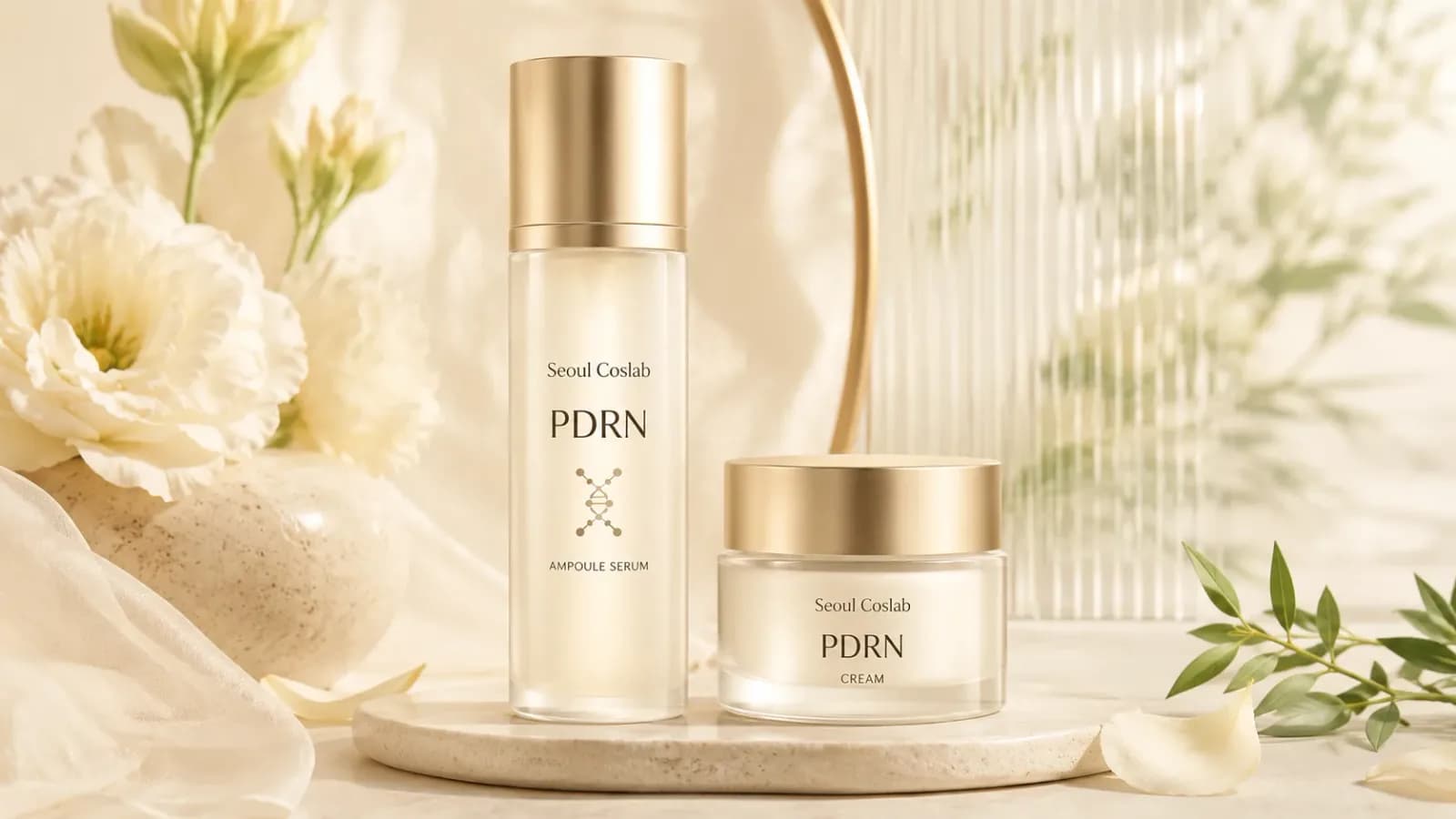
Most briefs that reach us about PDRN start the same way: a founder has seen the ingredient everywhere in Korean clinics and wants a serum built around it. The gap between that idea and a shippable product is mostly regulatory and formulation work, not sourcing. This page covers what PDRN actually is in a cosmetic context, which formats it suits, and what changes depending on whether you go the ODM, OEM or private label route.
What Is PDRN?
PDRN stands for polydeoxyribonucleotide — fragments of DNA, typically 50 to 1,500 base pairs long, most often extracted and purified from the milt (sperm) of salmonid fish such as chum salmon or rainbow trout. The material is deliberately fragmented and purified so that it is free of protein and peptide residue, which is what distinguishes a cosmetic-grade raw material from a crude fish extract.
The name matters more than founders expect. PDRN is not an INCI name. On an ingredient list your product will most likely declare Sodium DNA or DNA, sometimes alongside a manufacturer's trade name for the raw material. "PDRN" is a marketing and pharmaceutical term. In Korea it is best known as an injectable pharmaceutical used in clinics, and injectable PDRN is a drug, regulated as a drug, and has nothing to do with a topical cosmetic beyond the shared source material.
Cosmetic-grade material is supplied as a powder or a pre-solubilised aqueous solution, usually with a stated molecular weight range and purity specification. Two suppliers offering "PDRN" at the same percentage can differ substantially in fragment length distribution, ash content and endotoxin level — which is why we ask for full specifications and a certificate of analysis before a formulation route is chosen rather than after.
Why Brands Are Developing PDRN Products
Demand is downstream of the clinic. Korean aesthetic clinics popularised injectable polynucleotide treatments, consumers searched for the term, and the topical category grew to meet search demand that already existed. That is an unusual and favourable starting position for a new brand: the category has consumer awareness without needing to be explained from scratch.
Three patterns show up repeatedly in the briefs we receive:
- Post-procedure and barrier-support positioning. Brands pair PDRN with soothing and barrier actives and position the product for use alongside — never as a replacement for — clinical treatment. This is defensible if the language stays cosmetic.
- Premium ampoule sets. Single-dose glass ampoules carry a clinical visual code that supports a higher price point without requiring a higher-cost formulation.
- Ingredient-led line extensions. An existing brand adds one PDRN hero product to signal technical credibility across a range that is otherwise conventional.
The commercial risk in all three is the same: PDRN is now common enough that the ingredient alone is not a differentiator. What differentiates is concentration transparency, the supporting complex, the sensory profile and the packaging format.
Product Formats We Can Develop
PDRN is water-soluble and heat-sensitive, which makes it comfortable in most aqueous systems and awkward in a few. In order of how often we build them:
- Ampoules and serums — the natural home for the ingredient. Low viscosity, high water phase, cold or post-cool addition. See Korean serum and ampoule manufacturing for what the format involves at production scale.
- Emulsions and creams — workable, but the active goes in during cool-down, and the emulsifier system has to tolerate the electrolyte load. Covered under moisturiser and cream development in Korea.
- Sheet and hydrogel masks — high water content suits the active well, and the essence can be formulated at a higher active load than a leave-on. See Korean sheet mask manufacturing.
- Toner pads and essences — straightforward, though preservation of a high-water, high-surface-area format needs care.
- Anhydrous formats — generally the wrong choice. If a brief calls for a PDRN balm or oil, we usually recommend changing either the active or the format.
Developing a PDRN Product: ODM, OEM or Private Label?
This is the decision that determines your timeline, your cost floor and how much of the product you own. The right answer depends on whether you are bringing a formula, a concept, or only a brand.
Private Label
You select an existing PDRN base from our catalogue and apply your brand. Fastest to market, lowest development spend, and the formula is not exclusive to you.
ODM
We develop the formula against your brief — target texture, active complex, claim direction — and take it through to production. Longer, and the result is a product built for your positioning.
OEM
You supply the formula or a locked specification and we match it to a Korean facility that can produce it to that spec. Suits brands that already own a formulation or are transferring production to Korea.
For a first PDRN product, most brands should be looking at private label or ODM, and the honest dividing line is whether you have a positioning that an existing base cannot express. If your differentiation is the packaging, the brand and the market you sell into, a private label PDRN ampoule programme gets you there sooner and with less capital at risk. If your differentiation is the formula itself — a specific active complex, a particular texture, a claim you intend to substantiate — PDRN ODM development in Korea is the route that produces something you can defend.
OEM is the least common route for a first PDRN product, because very few new brands arrive with a formula they own. It becomes the right answer later, when you are moving an established product into Korean production or scaling a formula you already paid to develop.
Formulation Considerations
Use level. Cosmetic PDRN is typically used at low single-digit percentages of the raw material as supplied, which corresponds to a much lower percentage of actual DNA content. Ask any supplier — including us — to state which of the two numbers a claimed percentage refers to. Brands regularly find that two products advertising the same figure are not comparable.
Temperature. The material degrades with sustained heat. It goes into the batch during or after cool-down, never in the heated phase. This constrains emulsion manufacturing sequence more than it constrains serums.
pH. The comfortable working range is mildly acidic to neutral. Strongly acidic systems risk depurination and fragment shortening over shelf life, which is invisible at time zero and shows up only in accelerated stability.
Compatibility. PDRN sits well with humectants, panthenol, allantoin, centella derivatives, ceramides and most peptides. It is less comfortable with high concentrations of free acids, and combining it with cationic polymers can produce complexation and haze. Direct combination with strong exfoliating acids in a single formula is possible but usually not worth the stability work.
Viscosity and sensory. The raw material contributes a characteristic slip and, at higher loads, a slight stringiness that some consumers read as "rich" and others as "tacky". Which reading you want is a positioning decision, and it should be made before the first prototype rather than after panel feedback.
Preservation. A high-water, nutrient-bearing system needs a robust preservative approach and challenge testing. This is not optional, and it is where under-specified briefs most often lose time.
Our formulation development service works from a filled brief covering target use level, sensory direction, claim intent and destination market — those four together determine the formulation route.
Packaging Considerations
PDRN formulas are aqueous, mildly nutrient-rich and sensitive to prolonged oxygen and heat exposure, so packaging is a preservation decision, not only a branding one.
- Single-dose glass ampoules — best protection, strong premium signal, highest unit cost and the slowest fill. Well matched to the category's clinical positioning.
- Airless pump bottles — the practical default for a serum. Minimises headspace oxygen and eliminates finger contact.
- Dropper bottles — expected by consumers in this category, but the dropper reintroduces air and contact with each use. Requires a preservative system specified for it.
- Tubes — fine for creams, poor for low-viscosity serums.
- Sachets for masks — needs a barrier laminate; a thin single-layer film will not hold a high-water essence over a full shelf life.
Component decisions also carry regulatory weight in some markets, and lead time on a specialty component can exceed the formulation timeline. We source and qualify components through Korean cosmetic packaging sourcing alongside formulation rather than after it, because a late component change usually means repeating stability work.
Claims and Regulatory Notes by Market
PDRN is where cosmetic and pharmaceutical language sit uncomfortably close together, and the claim set has to be written per market. What follows is orientation, not a compliance opinion.
United States. Classification turns on intended use. A product intended to affect the structure or function of the body is a drug under the FD&C Act regardless of how it is labelled — the FDA guidance on whether a product is a cosmetic, a drug, or both is the primary reference. Claims about regeneration, healing, repair of tissue, or acceleration of recovery after a procedure are the ones that push a topical PDRN product across the line. Separately, MoCRA introduced facility registration, product listing, a responsible person and safety substantiation requirements that apply to imported product.
European Union. Cosmetic status is governed by Regulation (EC) No 1223/2009. Ingredient declaration uses INCI, the ingredient must be checked against the CosIng annexes, and every product requires a Product Information File, a safety assessment by a qualified assessor, an EU Responsible Person and CPNP notification before it is placed on the market. Claims must satisfy the common criteria — in practice, evidential support and no implication of a medicinal effect.
Korea. Cosmetics fall under the Cosmetics Act, administered by the MFDS. Korea's functional cosmetics category covers a defined list of functions and actives — wrinkle improvement, brightening, UV protection and others — and PDRN is not among the designated functional actives. A PDRN product may still be registered as a functional cosmetic if it contains a listed functional ingredient at the specified level, but the functional claim then belongs to that ingredient, not to PDRN.
A note on sourcing. Fish-derived material raises questions in some markets and with some consumers — halal and kosher certification, and vegan positioning, are all affected. If any of those apply to your market, raise it in the brief rather than after the formula is locked.
MOQ and Development Timeline
We do not publish minimum order figures, because a single number would be wrong for almost every brief that reaches us. What actually sets your minimum is the combination of:
- Format — a filled ampoule set and a tube cream have different minimums for the same volume.
- Packaging — stock components are ordered in far smaller quantities than custom moulds or custom decoration, and the component minimum usually exceeds the fill minimum.
- Route — private label from an existing base starts lower than ODM development, which carries its own development cost regardless of first-order size.
- Formula — a specialty raw material with its own supplier minimum can set the floor for the whole project.
- Market — market-specific labelling, registration or certification adds per-market cost that changes the economics of a small first run.
How cosmetic MOQ is actually determined sets out how these interact, and what to change if the first quote comes back above your budget. As a planning frame, a private label programme moves faster than an ODM development, and in both cases stability and challenge testing occupy a fixed block of calendar time that cannot be compressed by paying more.
Frequently Asked Questions
Is PDRN the same thing in a cosmetic as it is in a clinic injectable?
No. The source material is related, but an injectable polynucleotide product is a pharmaceutical, regulated as a drug, with clinical evidence generated for that route of administration. A topical cosmetic containing Sodium DNA is a cosmetic and cannot borrow either the evidence or the language of the injectable. Treating them as interchangeable is the most common compliance mistake in this category.
What will PDRN be called on my ingredient list?
Most often Sodium DNA, sometimes DNA, depending on the raw material and the market. PDRN itself is not an INCI name, so it belongs in your marketing copy — subject to each market's claim rules — rather than in the ingredient declaration. We confirm the exact declaration for your destination market before artwork is finalised.
Can I say my PDRN serum repairs or regenerates skin?
In most markets, no. Repair and regeneration claims describe an effect on the structure or function of the body, which is drug language rather than cosmetic language in both the US and the EU. There is a workable cosmetic vocabulary for this category, and part of an ODM brief is agreeing on it early — rewriting a claim set after packaging is printed is expensive.
Should I start with private label or ODM for my first PDRN product?
If your differentiation is brand, packaging and market, private label gets you to shelf sooner with less at risk. If your differentiation is the formula — a specific complex, a specific texture, a claim you intend to substantiate — ODM is the only route that produces something you own the positioning of. Bringing an existing formula to Korean production is the OEM case.
Can PDRN be combined with exosomes, peptides or centella in one formula?
With peptides and centella, routinely — these are common and well-behaved combinations. Combining multiple headline biotech actives in a single formula is possible but raises cost, stability work and the difficulty of substantiating what each contributes. We usually recommend one lead active with a supporting complex over two competing headline actives.
Do you provide documentation for import and registration?
We provide the manufacturing-side documentation a brand needs for import and registration — specifications, certificates of analysis, allergen and composition statements, and testing reports. Registration itself is filed by the importer or the responsible person in your market. See exporting cosmetics from Korea for what we supply and where the handover sits.
- Is It a Cosmetic, a Drug, or Both? (Or Is It Soap?) — U.S. Food and Drug Administration
- Modernization of Cosmetics Regulation Act of 2022 (MoCRA) — U.S. Food and Drug Administration
- CosIng — Cosmetic Ingredient Database — European Commission
- Cosmetic Regulatory Framework in Korea — Ministry of Food and Drug Safety, Republic of Korea
This page is general information for manufacturing planning. It is not legal or regulatory advice, it has no legal effect, and no rights can be derived from it. Requirements change by market and over time — before acting on anything here, confirm the current position with the authority concerned or with qualified counsel.