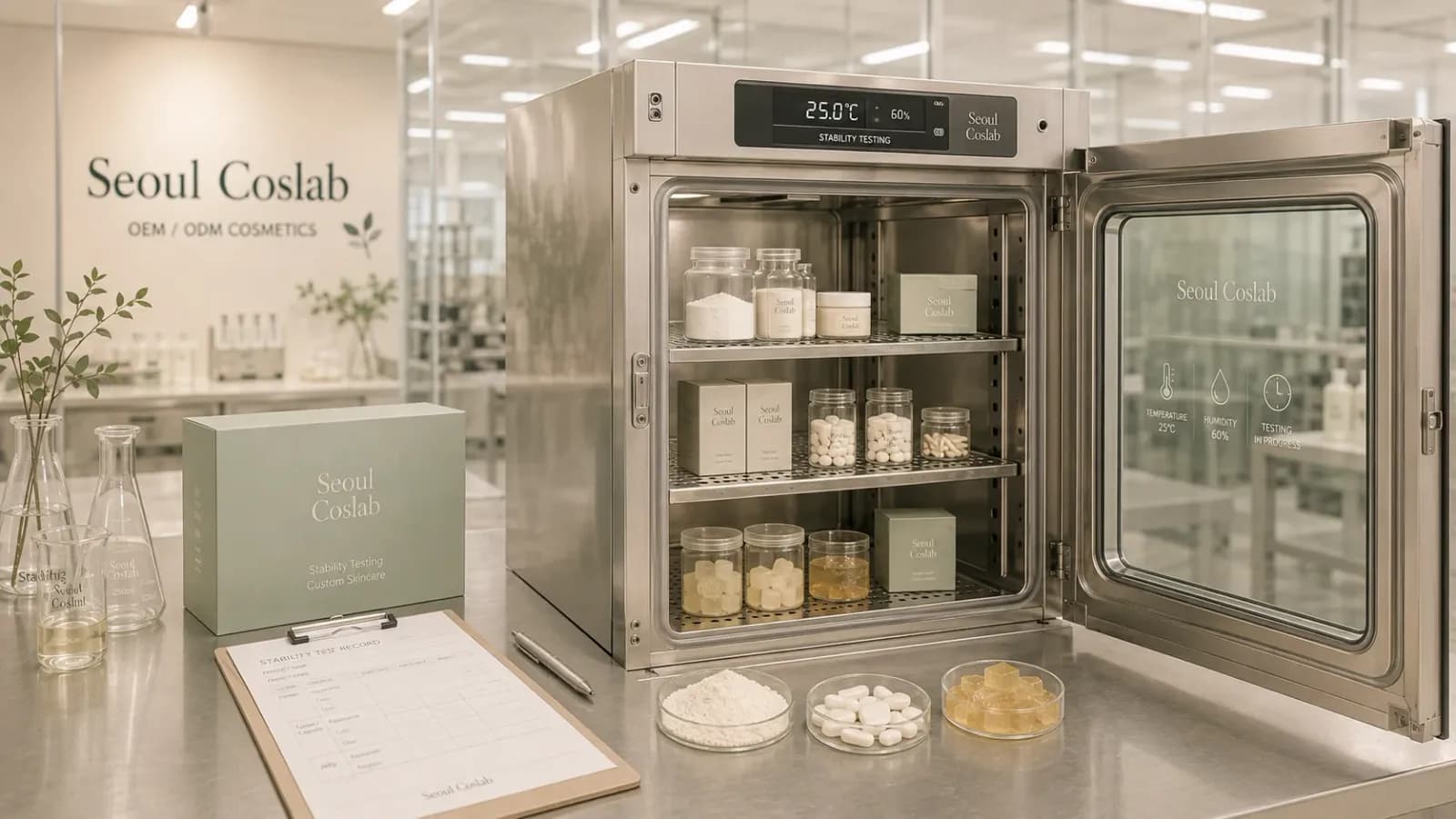
Stability testing is the part of a development schedule that cannot be shortened by paying more, and it is therefore the part that most often breaks a launch date set from a marketing calendar. It is also the part brands understand least, which is why "can we start production while testing runs?" comes up in almost every project.
This article covers what the testing is actually for, what accelerated conditions can and cannot tell you, and which failure modes only ever appear in real time.
What Stability Testing Is For
A cosmetic has to be the same product when a customer opens it as it was when it left the line — after months in a warehouse, a container, a shop shelf and a bathroom cabinet. Stability testing is how you find out whether it is.
Four things are being watched.
Physical stability. Does the emulsion separate, does the viscosity drift, does the colour change, does a crystalline ingredient come back out of solution? Some of these are cosmetic defects a customer will complain about; some indicate the formula is coming apart.
Chemical stability. Do the actives degrade? A peptide hydrolysing at low pH, a vitamin C derivative oxidising, a plant extract browning — none of these are visible on day one and all of them mean the product a customer buys in month nine is not the product you substantiated.
Microbiological stability. Does the preservative system hold up? This is tested separately, by challenge testing, and it is the one with actual safety consequences.
Compatibility with the pack. The formula and the container are one system. Testing a formula in a lab jar tells you nothing about what it does to a dropper bulb or what a tube's inner liner does to it over a year.
Real-Time and Accelerated Are Not Substitutes
Two protocols run in parallel, and understanding the difference is what stops brands from asking for the impossible.
Real-time testing holds the product at normal storage conditions for its intended shelf life, and observes. It gives you the answer. It also takes as long as the shelf life you are claiming, which is why no launch waits for it to complete.
Accelerated testing holds the product at elevated temperature — and often through freeze-thaw cycles and light exposure — on the principle that stressing a formula surfaces in weeks what would otherwise take months. It gives you an early, usable read.
The relationship between them is the thing to be honest about. Accelerated testing predicts real-time behaviour; it does not prove it. The chemistry does not scale perfectly, and some failure modes are not accelerated by heat at all. So a normal launch proceeds on accelerated results while real-time testing continues in the background and confirms — or occasionally does not — what the accelerated data suggested.
Standard practice is to run both from the same batch, at several conditions, with defined observation points, against acceptance criteria agreed in advance. Criteria agreed in advance is the part that matters: deciding after the fact whether a colour shift is acceptable is not a test, it is a negotiation.
What Accelerated Testing Misses
This is the section worth reading twice, because these are the failures that arrive after launch.
Slow recrystallisation. Ingredients that were dissolved at temperature can come back out of solution over months. Ceramides are the classic case — a barrier cream that passed everything at time zero turns gritty in month four. Heat does not accelerate this; in some cases it delays it, because the ingredient stays dissolved while warm. See ceramide formulation and why the cooling profile is part of the formula.
Slow phase separation. A marginal emulsion can look perfect for months and then break. Elevated temperature finds gross instability quickly but is unreliable for the marginal case.
Fragrance drift. Top notes fade and some fragrance components react with the base over time. Accelerated conditions distort this rather than predicting it.
Packaging interaction over real time. Migration between a formula and a component, or slow degradation of a gasket or a dropper bulb, happens on its own clock.
Cold-chain and climate reality. Standard conditions assume a temperate distribution chain. If your product ships to a Gulf market or across tropical Southeast Asia, warehouse and retail conditions are harsher and longer than the protocol assumes. Say where the product is going during development so the protocol reflects it.
Challenge Testing Is a Separate Thing
Preservative efficacy testing — the challenge test — is often lumped in with stability and should not be. It answers a different question with different consequences.
A challenge test deliberately inoculates the product with specified microorganisms and measures whether the preservative system reduces them over a defined period. Stability failures produce complaints; preservation failures produce safety incidents.
Three things brands should know:
It is not optional. Any water-containing product needs it, and the result is part of the safety substantiation file that markets like the US and the EU expect you to hold. See what MoCRA expects of an imported product.
It constrains the formula. A "preservative-free" positioning is a formulation constraint with real consequences — it usually means a different pack, a shorter period after opening, or an alternative system that has to pass the same test. Raise it in the brief, not after.
It is tested in the final pack. A formula preserved adequately in an airless pump may not be in a jar, because a jar is opened, touched and re-closed daily. This is one of the reasons the pack cannot be decided after the formula.
Why It Sits on the Critical Path
Here is the sequence that makes stability unavoidable and unshortenable.
- Formula is agreed after sampling rounds
- Packaging components are confirmed — because testing runs in the final pack
- A test batch is produced
- Stability and challenge testing run
- Results are reviewed against the acceptance criteria
- Production proceeds
The block sits between "we like the sample" and "start production", and it does not compress. There is no premium version that runs faster, because the constraint is elapsed time under conditions, not throughput.
What can be compressed is everything around it:
- A precise brief cuts sampling rounds, and each round saved is two to three weeks before testing even begins. This is the single largest lever a brand controls — see how to brief a Korean formulation lab.
- Deciding packaging early lets the test batch be made in the real pack the first time. Changing the pack after testing means testing again.
- Starting private label skips the block entirely for a first launch, because an existing base already has its data. The trade-off is set out in OEM, ODM and private label compared.
- Running artwork and registration in parallel with testing rather than after it.
What Comes Out of It
The documentation is not a by-product. It is an asset you will be asked for repeatedly.
- Stability report — conditions, observation points, results against criteria
- Challenge test report — organisms, inoculum, log reduction over the period
- Compatibility report — formula against the specific pack
- Certificate of analysis — per batch, against the finished specification
- Period after opening or durability — the number that goes on the label, derived from this data
Every market you enter will want some subset of this. So will retailers, and retailer requirements frequently exceed the legal minimum. A brand that keeps this documentation organised from the first batch adds markets cheaply; one that does not pays to reconstruct it each time.
Our quality control and testing process produces this documentation as part of development rather than as a separate exercise, and packaging is qualified alongside the formula so the test batch is made in the pack that ships.
Frequently Asked Questions
How long does stability testing take?
Accelerated testing gives a usable read in a matter of weeks; real-time testing runs for the shelf life you intend to claim. A normal launch proceeds on accelerated results with real-time continuing in the background. The block cannot be shortened by paying more — the constraint is elapsed time under defined conditions, not laboratory capacity.
Can we start production while stability testing runs?
It is possible and it is a risk you are choosing to take, not a shortcut. If the formula fails, you own finished goods you cannot sell. Brands sometimes accept this on a repeat product with a known base; on a new formula it is rarely worth it. The safer version of the same instinct is to run artwork, registration and logistics in parallel instead.
Does accelerated testing prove the product is stable?
It predicts, it does not prove. Elevated temperature surfaces many failure modes early, but slow recrystallisation, marginal phase separation, fragrance drift and packaging interaction all run on their own clock and some are not accelerated by heat at all. Real-time testing is what confirms.
Do we need to test in the final packaging?
Yes, and it is the reason packaging cannot be decided after the formula. A formula behaves differently in an airless pump, a dropper bottle and a jar — for oxygen exposure, for contamination risk and for the preservative demand each pack places on the system. Testing in a lab jar and shipping in a dropper bottle means you tested a different product.
What is the difference between stability and challenge testing?
Stability watches whether the product stays the same — physically, chemically, and in its pack. Challenge testing deliberately contaminates the product and measures whether the preservative system controls the organisms. Stability failures cause complaints; preservation failures cause safety incidents. Both are required for a water-containing product, and both belong in your safety documentation.