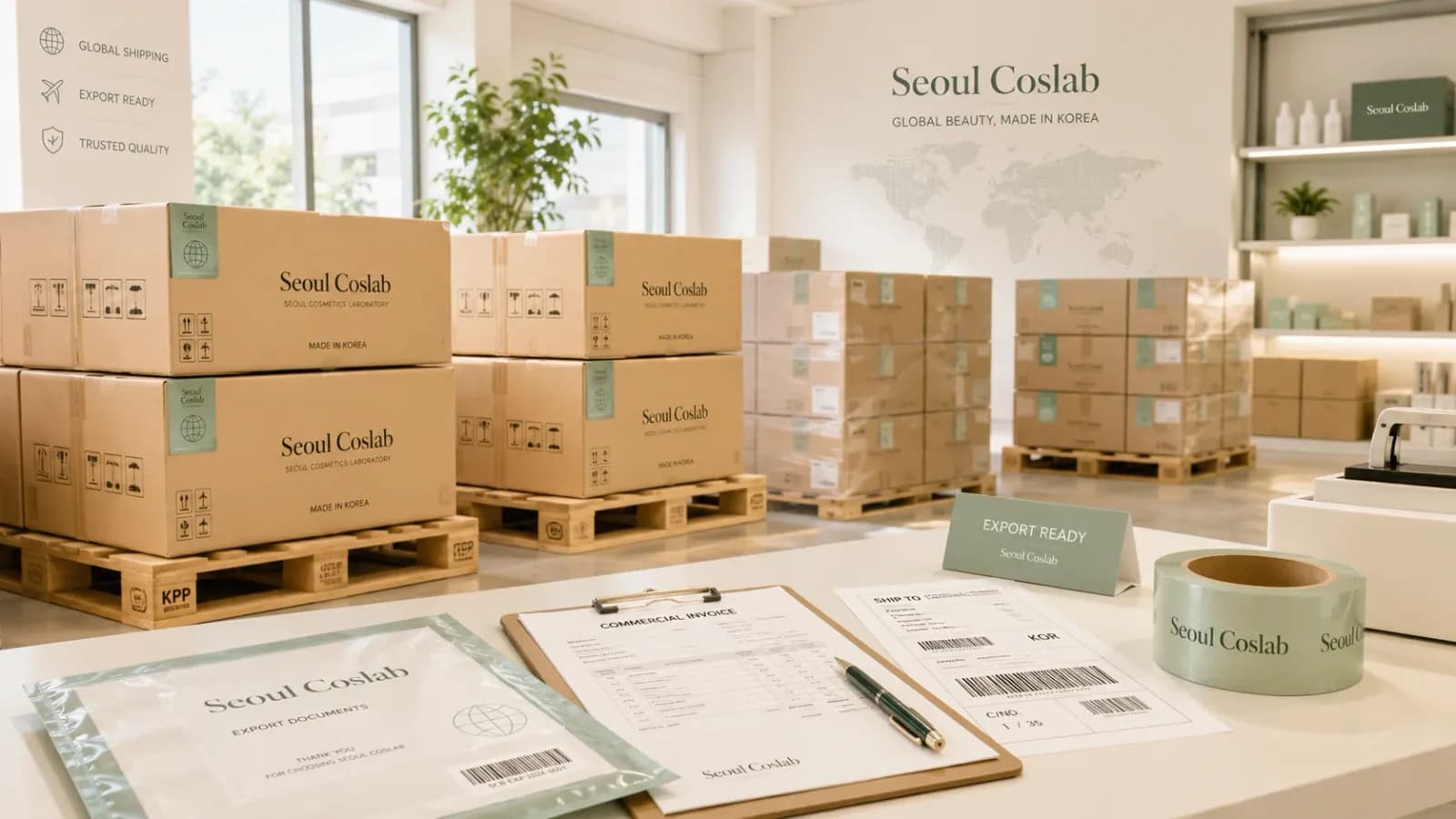
A finished product is not yet a shippable product. Shipments are held far more often for a document than for anything about what is inside the bottle — a certificate naming the wrong entity, a test report describing a different batch, an authentication step nobody started.
Most brands meet these documents one at a time, as a request from a forwarder or an importer, and treat them as forms to be filled. They are not forms. Each one is a statement made by a different party about a different thing, and they cannot be collected in any order you like, because some of them describe something that does not exist yet.
This article covers what each document claims and why the order of collection matters. It is orientation, not a compliance opinion. Which documents your destination asks for is a question for that destination — what each market requires sets out the markets we cover, and the primary sources are at the end.
What Each Document Is Proving
Four claims come up in almost every export file. Naming the claims first makes the documents much easier to keep apart.
- That the product is sold at home. The market where it is made has accepted it, so the importing market is not the first to see it.
- That this batch meets its specification. Not the formula in general — the material in these cartons.
- That the site is operated to a manufacturing standard. A statement about premises, equipment, documentation and batch release, not about your formula.
- That it was made where you say it was made. Origin, which also appears in the label requirements of markets we cover.
One document almost never covers two of these claims. That is the most useful thing to know about the whole set: an importer asking for a fourth document is usually asking for a fourth claim rather than being difficult.
The Certificate of Free Sale Answers One Question
A certificate of free sale (CFS) confirms that the product is freely sold in its country of origin. For a Korean-made cosmetic, it is issued in Korea and then presented to the destination market.
Three consequences follow, and brands lose time at each of them.
It travels outward from the country of manufacture. It is not a document your importer obtains locally. If the product is made in Korea, the certificate comes from Korea, whichever market you are selling into and whatever the document is called there.
It describes commercial status at home, not the formula and not the batch. A market that wants an ingredient assessment asks for an ingredient assessment; one that wants test results asks for test results. This certificate stands in for neither.
Its name in another language is frequently not a translation. That has its own section below.
Two of the markets we cover state the requirement plainly. A Vietnamese launch normally needs a certificate of free sale issued in Korea and legalised for use in Vietnam. The Indonesian notification dossier is assembled from product identity, the formulation frame, manufacturer documentation and a certificate of free sale or equivalent, with legalisation where required. Elsewhere the requirement differs. Take the list from the market you are entering rather than from an article.
The Certificate of Analysis Belongs to a Batch
A certificate of analysis (CoA) records the test results for one batch. That is the entire definition, and it is also the constraint: the document cannot exist before the batch it describes.
Document planning and production planning collide at exactly this point. A brand assembles its export file during development, puts everything else in place, and then finds that the one document describing the goods actually in the cartons is generated at the end — after filling, after release testing.
Two practical consequences:
Ask for one per batch, every batch. A second shipment is a second batch with its own results. Reusing the first certificate is not a shortcut; it is a mismatch waiting to be found.
Check that the specification behind it is the specification you agreed. The document is worth exactly what that specification is worth, and which party signs the specification is one of the questions to settle before you commit — see how to vet a Korean cosmetics supplier.
Batch documentation comes out of cosmetic quality control and testing in Korea as a by-product of normal production. Receiving it as it is generated costs nothing; reconstructing it afterwards is expensive.
The GMP Certificate Belongs to a Site
CGMP in Korea and ISO 22716 internationally are both good manufacturing practice (GMP) frameworks, and both attach to a production site rather than to a product or to a company. They cover premises, equipment, personnel, documentation and how a batch is released. They say nothing about any individual formula.
Two things follow.
A certificate covers only the operations printed on it. That list of operations — its scope — is part of the certificate itself. A site certified for one kind of operation is not thereby certified for another: a line certified for emulsions is not certified for aerosols.
"Our partner is certified" is not an answer. The useful question names the site and the line your product will actually run on. What a certificate actually covers draws the same distinction for the other schemes buyers ask us about, halal, vegan and organic marks among them.
Our own position belongs in the open here: Seoul Coslab does not own production lines and holds no manufacturing certification of its own. These certificates belong to the plants. Once a partner is matched to your project we confirm the current certification and its scope for that specific line and send you the evidence rather than a claim.
A Product Information File Is Not a Certificate
One item in a typical export file is not a certificate at all, and treating it as one is a common mistake. A product information file is a dossier held by a party in the destination market and made available to the authorities on request. Nobody issues it, nobody stamps it, and you cannot order one.
What a manufacturer contributes to it is substantial: the full quantitative formula, raw material specifications, the manufacturing method, a statement of compliance with good manufacturing practice, and stability and challenge data. A manufacturer cannot hold it. In the EU the holder is the responsible person, and that role requires establishment in the territory — CPNP notification for a Korean-made cosmetic sets out that sequence in order. A file of the same kind appears outside Europe under other frameworks; in a Thai launch it is held in Thailand by the local notification holder, and we supply the manufacturing method and site documentation that goes into it.
So when an importer asks you for "the PIF", they are asking for the manufacturing-side content of a file they will assemble and keep themselves. A folder of certificates does not answer that request.
The Name Changes From Language to Language
This problem costs days rather than money.
The certificate of free sale is called different things in different places, and the pattern is not the one you would guess. Some languages have an established native name, and the document is issued under that name. Others keep the English name inside their own official documents, so an invented translation identifies nothing at all — the person you sent it to searches for a document that does not exist under that name, and concludes you are asking for something unusual.
Two rules come out of this.
Name the document as it is named where it is issued, and again as it is named where it is filed. Putting both names in one email removes a whole round of confusion.
A free-sale scheme you find is not necessarily the one covering cosmetics. Some countries operate these per product category, so the scheme that surfaces first can belong to food or to another sector while cosmetics sit under a separate framework. Confirm the category before anyone starts an application.
We keep this document's name, language by language, in one place, so that every page of this site calls it the same thing in each language it is published in. It is small housekeeping against a recurring failure.
Translation, Notarisation and Legalisation Are a Separate Timetable
Obtaining a document is one job. Making it usable in the destination market is a second job, and it follows a calendar you do not control.
Where a market requires it, a certificate of free sale and a power of attorney have to be issued, notarised and legalised before they can be filed. The Vietnamese route is the clearest case among the markets we cover: legalisation keeps its own timetable and is usually the critical path, rather than the filing itself. Brands consistently underestimate it, and the underestimate is structural — the filing looks like the milestone, so the authentication in front of it gets planned as an errand.
Three things make it slower than expected.
- It is a chain, not a step. Issuing, notarising and legalising are three separate links, and not every destination asks for the same chain. The Indonesian dossier asks for legalisation where required; it does not come up in every market.
- Each link accepts only the output of the one before it. The steps cannot be taken at the same time.
- A correction can send the document back to the beginning. A company name spelled differently from the registration, a superseded address, a signatory who has left the company — any of these is enough.
The third point is why a boring step deserves attention: verify the exact legal names and addresses of every party before anything is signed, not after.
The Order That Makes the Rest Possible
The sequence below is not a regulatory requirement. Following it keeps each step from blocking the next one.
- Decide the destination markets before the formula is final. Documents are the visible half of a market decision. The formula is the expensive half.
- Settle who holds the filing locally. In most markets we cover, a notification or registration is filed and held by an entity established there, and that party's exact legal name will appear on documents you are about to have authenticated.
- Collect the manufacturing-side documentation as it is generated. Specifications, the manufacturing method, the good manufacturing practice statement, stability and challenge reports — all of it is produced during ordinary development.
- Start the certificate of free sale, any authorisation document, and the authentication chain together. Where a market requires authentication, this is usually the critical path.
- Take the certificate of analysis at batch release. It cannot arrive earlier, so plan the document pack around it instead of around the shipping date.
- Leave the artwork until last. Label requirements are set per market — language, mandatory particulars, importer details — and reprinting is one of the more expensive corrections in this sequence.
What Sits With Us and What Sits With You
We prepare and supply the manufacturing side: the full quantitative formula and specifications, certificates of analysis by batch, stability and challenge reports, manufacturing statements, and support for the certificate of free sale application. That work is described on exporting cosmetics from Korea to your market.
Four things sit outside what we can do, and saying so early saves a conversation later.
- We do not hold legal roles in your market. A responsible person in the EU or the UK has to be established there. The pattern repeats elsewhere: notification holders and licence holders are local entities.
- We do not own factories. Manufacturing certificates belong to the partner plants, and we confirm the scope for your line instead of presenting a certificate as ours.
- We do not file on your behalf. Filings are made by the party that holds them.
- This is not legal or regulatory advice. Requirements change. Confirm the current obligations for your product with a qualified adviser in your market.
Frequently Asked Questions
What is a certificate of free sale, and where does it come from for a Korean-made product?
It confirms the product is freely sold in its country of origin. For a Korean-made cosmetic it is issued in Korea and then presented in the destination market, after legalisation where that market requires it. It is not a document your importer obtains locally. We support the manufacturing-side application; the authentication timetable sits with you and your partner, and it should be started early.
Is a certificate of analysis the same as a test report?
It is one particular kind of test report. A certificate of analysis records results for a single batch against an agreed specification, which is why it cannot exist before that batch is made. Development reports — stability, challenge, compatibility — describe the formula and the pack rather than a batch, and they are produced much earlier. An export file commonly needs both.
Can you send us your GMP certificate?
Not one of our own: Seoul Coslab does not own production lines, so no manufacturing certificate exists in our name. What we do instead is confirm the current certification and its scope for the specific site and line your product will run on, then send that evidence. Scope matters more than presence — a certificate covers the operations printed on it and no others.
Do all markets ask for the same documents?
No, and that is why this article contains no checklist. The underlying claims are similar everywhere — sold at home, batch conforms to specification, site operated to a standard, origin — but which documents are asked for, in what form, and with which authentication steps differs by destination. Take the list from the market you are entering.
Why does legalisation take so long?
Because it is a chain rather than a single step: each link accepts only the output of the previous one, so the steps cannot be taken at the same time, and a correction anywhere can send the document back to the start. Its duration also sits outside the manufacturer's control. Where a market requires it, treat it as the critical path and begin as soon as the parties' legal names are fixed.
Who holds the documents once we are selling?
Depending on the market, a local notification holder, licence holder or responsible person. That party is normally also the one the authorities deal with, which makes it a commercial question as much as an administrative one. Agree in writing what happens to the filing if the relationship ends, before the first shipment rather than after.
- Regulation (EC) No 1223/2009 on cosmetic products — EUR-Lex, European Union
- Cosmetic Regulatory Framework in Korea — Ministry of Food and Drug Safety, Republic of Korea
- Drug Administration of Vietnam — cosmetics administration — Ministry of Health, Socialist Republic of Vietnam
- BPOM — National Agency of Drug and Food Control — Badan Pengawas Obat dan Makanan, Republic of Indonesia
This page is general information for manufacturing planning. It is not legal or regulatory advice, it has no legal effect, and no rights can be derived from it. Requirements change by market and over time — before acting on anything here, confirm the current position with the authority concerned or with qualified counsel.