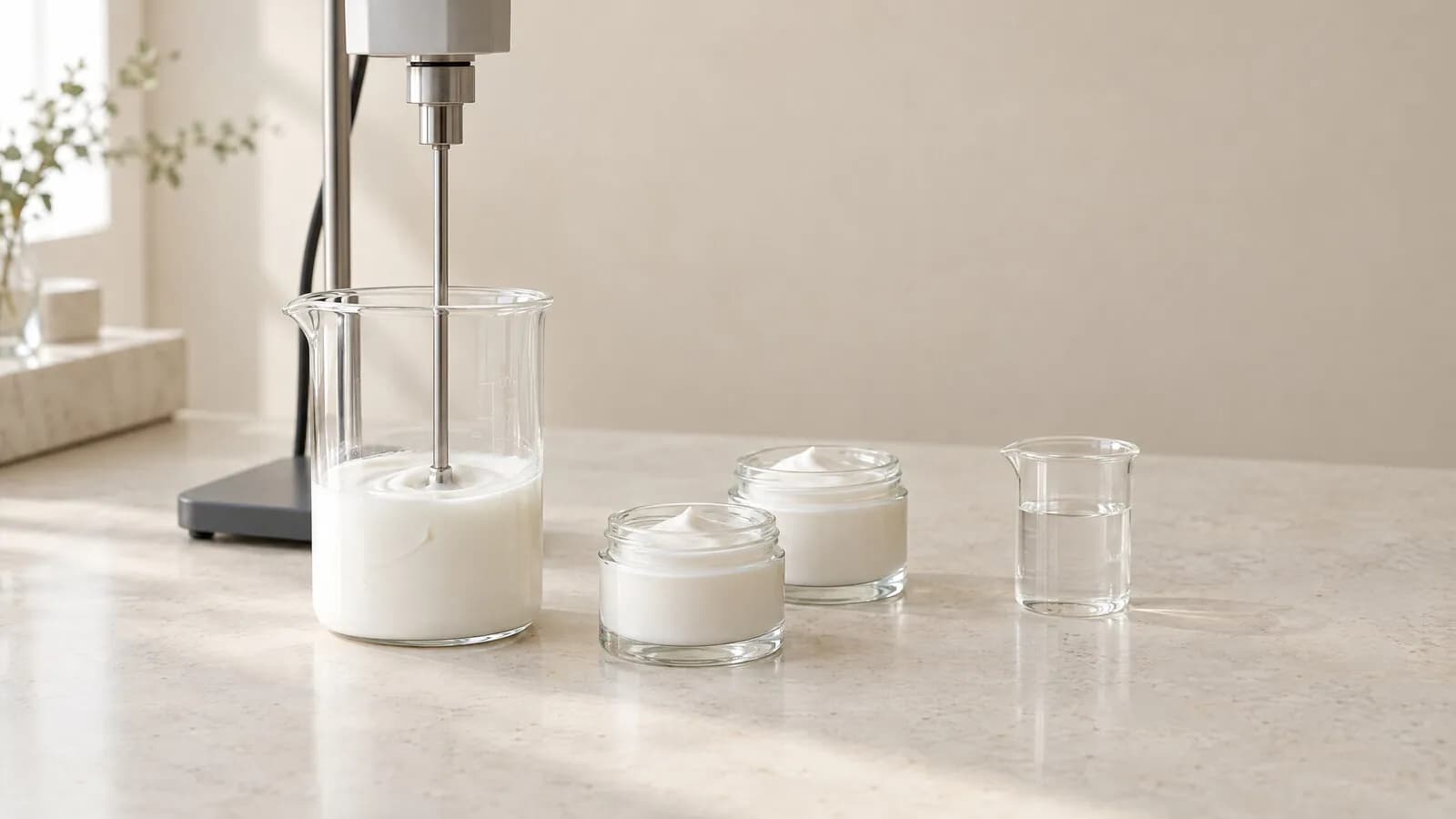
A cosmetic lab sample and a production batch can share one formula and still behave differently, because mixing energy, heating and cooling rates and the timing of additions all change with vessel size. A pilot batch is the scale-up step that finds those differences on a run small enough to correct, before a full batch commits bulk, packaging and time.
This article is for the brand that has approved a sample and is about to move into production, or the one that already received a batch that did not feel like the sample. How the sample itself gets approved is covered in how the sampling process works. What follows starts where that article ends: the formula is fixed, and the question is whether the factory can make the same product at volume.
Why Does a Production Batch Differ From the Lab Sample?
A production batch differs from the lab sample because a formula is a list of ingredients and amounts, and a product is that list plus the way it was made. The lab sample was made by a formulator in a beaker or a small mixer, often in one sitting, with every step watched by hand. A production batch is made in a vessel many times larger, by a process written down for operators, on equipment with its own speeds, heating jackets and pumps.
Most of the properties a customer notices are set partly by process. Viscosity, the way a cream breaks on the skin, how glossy a gel looks, how long an emulsion stays smooth: all of them depend on droplet size, polymer structure and crystal formation, and those depend on how much energy went in, for how long, and at what temperature. Keep the formula identical, change the process, and you can change the product.
So "the batch is different from the sample" rarely means someone changed the formula. Usually it means the process that made the sample was never fully written down, and the production process filled the gaps differently.
What Changes With Vessel Size
Several things do not scale in a straight line when a batch gets larger. The table sets out the usual ones, and the sections below explain each.
| What changes | In the lab | In a production vessel | What it can do to the product |
|---|---|---|---|
| Shear and mixing | A small high-shear mixer reaches the whole sample | Energy is spread through far more volume, from different mixer designs | Different droplet size, viscosity and texture |
| Heating and cooling | The sample heats and cools quickly | Each step takes longer because there is less surface per unit of volume | Different crystal structure, viscosity build and time at temperature |
| Air | Little air, easy to see and remove | Vortexes and transfers can draw air in | Foam, lower density, fill-weight drift, faster oxidation |
| Order and timing of additions | Each addition is near-instant | Adding a phase or powder takes time and has to be dispersed | Lumps, incomplete hydration, a different emulsion |
Shear and mixing
In the lab, a small homogeniser can put intense shear through the whole sample. In a production vessel, the same work is shared between an agitator that moves the bulk, a homogeniser that does the fine work and often a recirculation loop. Those pieces do not deliver energy the way a lab mixer does, so matching "the same speed" or "the same minutes" does not give the same result.
Too little shear leaves larger droplets, which can feel heavier and separate sooner. Too much can be just as damaging: some thickening polymers lose viscosity when sheared hard, and a gel that held its shape in the lab can arrive thinner. The fix is a set of process settings found on that equipment, not a change to the formula.
Heating and cooling rates
A larger vessel has less surface area for each unit of volume, so it heats and cools more slowly. A step that took minutes on the bench can take far longer in production, and a batch can spend more time at high temperature than the sample ever did.
That matters in two directions. Heat-sensitive actives and fragrance spend longer near the temperature where they degrade. And many textures are set during cooling: the gel network that gives a cream its body, or ingredients that have to stay dissolved as the batch cools. Ceramides are the best-known case, which is why ceramide creams treat the cooling profile as part of the formula. A different cooling curve can give a cream that passes on day one and turns grainy weeks later.
Air
A vortex during mixing, a pump transfer or a powder added too fast can all draw air into the batch. Production vessels are often vacuum emulsifying mixers for exactly this reason. Air that stays in lowers the density, so a pump or tube filled by volume holds less product by weight. It can make a clear gel cloudy, and it gives oxygen more contact with ingredients that oxidise.
Order and timing of additions
A formulator adding a preservative or a thickener to a beaker does it in seconds. In a production vessel the same addition takes longer, has to be dispersed through far more material and may happen while the batch is still cooling. Gums that hydrate unevenly form lumps. A neutralising step done at a different point gives a different viscosity. A phase added at the wrong temperature can give a different emulsion. The lab procedure has to become a written sequence: what goes in, at what temperature, at what mixing setting and how long it is held.
Fragrance, Colour and Raw-Material Lots
Some differences between sample and batch have nothing to do with the vessel. They come from the materials.
Fragrance. The same fragrance can read differently in a larger batch, partly because of the time at temperature described above and partly because a sample is often smelled fresh, before the fragrance has settled into the base. Compare fragrance after the batch has rested, against a reference sample of the same age.
Colour. Natural extracts, clays and some actives vary in colour from lot to lot. A product coloured only by its ingredients can come out a shade darker or lighter with nothing wrong in the process. If colour matters to the brand, it needs a range and a reference, not a single remembered shade.
Raw-material lots. Plant oils, extracts and some functional ingredients differ slightly between harvests and production lots. The lab sample was made from whatever lot was on the shelf, and production may use a newer one. Lot changes are normal; what you agree in advance is how they are checked. Substituting a different supplier's ingredient is a separate matter. It changes the formula and should never happen without your approval.
What Is a Pilot Batch For?
A pilot batch is an intermediate run made on equipment that behaves like production, sized so that a problem costs a correction rather than a full batch of bulk and packaging. Its job is to turn the lab procedure into a production process and to prove that the process gives the approved product.
In practice it answers four questions:
- Do the process settings work? Mixing speeds and times, temperatures, hold times and the order of additions are set on equipment like the line that will run the product, then recorded.
- Does the result match the reference sample? The pilot material is compared with the approved sample on appearance, texture, fragrance and measured properties.
- Does it fill and dispense properly? Pilot material can go through fill trials in the real components: whether a pump primes, whether a dropper delivers, whether a tube seals cleanly.
- Is the material representative for testing? Stability and compatibility results mean most when they come from material made the way production will make it, in the final pack.
How many pilot runs a project needs, and how large they are, depends on the formula, the facility and how far the production equipment is from the lab's. When a formula moves to a new line, we treat that transfer as a controlled step rather than a handover, usually with pilot batches, and coordinate it with the partner manufacturer whose line in Korea will make the product. The same step is part of moving an existing formula into Korean production.
What Gets Checked Before Release
Before a production batch is released, it is checked against a specification agreed in advance. The exact list differs by product and manufacturer, but the usual items are these:
- Appearance, colour and odour against the reference sample
- Viscosity, measured by a stated method, against an agreed range
- pH, against an agreed range
- Density or specific gravity, which also tells you whether air has been trapped
- Microbiological quality, against the limits the destination market recognises
- Fill weight or volume, and how the container, closure and pump perform on the line
- Packaging fit: leaks, closure torque where relevant, print and label placement
Stability on representative material starts alongside, because a batch can pass every release check on day one and still change over the following months. What that testing can and cannot show is set out in what stability testing tells you, and when, and quality control and testing in Korea covers how the specification and the inspection against it fit into a project.
Why Does Scale-Up Affect Minimum Order Quantities?
The bulk batch is one of the six separate minimums on the minimum order quantity guide, and scale-up is a large part of the reason. A production vessel has a floor below which the formula will not emulsify or disperse properly. Mixers cannot reach a batch that sits too low in the vessel, and the process settings found in the pilot hold only in the range they were proven for.
Scale-up work is also a fixed cost. Writing the process, running a pilot and checking it against the reference take the same effort whether the first order is small or large, and that cost has to be spread across the units that follow. This is one reason a base the manufacturer already produces can allow a smaller first run: its process has been proven on that line before. How to reduce your MOQ covers that lever and the others.
How to Brief for Scale
Most scale-up surprises can be prevented on paper, before the first pilot.
Write targets as ranges. "Like the sample" cannot be measured on a production floor. A viscosity range with the method used, a pH range, a description of appearance and the fragrance character give the manufacturer something to hit and something to check against. The lab can help set those numbers from the approved sample. Turning a description into a measurable specification is part of cosmetic formulation development.
Approve a reference sample and keep it. Ask for a retained reference from the approved round, labelled and kept by both sides. Every comparison that follows, from the pilot to each production batch, is made against that physical sample rather than against anyone's memory of it.
Agree tolerances before production. Decide what counts as a pass before the first batch exists: how far viscosity may move within the range, which colour shift is acceptable, what happens when a batch falls outside. Tolerances negotiated after a batch arrives become an argument about money.
Fix the packaging first. Fill trials and compatibility testing need the real components. A change of pump or bottle after the pilot reopens both.
Say where the product will be sold. Hot, humid distribution chains put more stress on an emulsion than temperate ones. Naming the destination markets early lets testing reflect them.
Leave room in the calendar. A pilot that finds a problem is doing its job, and the correction takes time. Where scale-up sits in the overall schedule is set out in Korean cosmetics lead times.
Frequently Asked Questions
Is a pilot batch always needed?
Not always as a separate run. A base the manufacturer already produces on the same line has a proven process, and adjusting it slightly may need less. A new formula, a formula moving to a different facility, or a significant change to process or packaging usually warrants a pilot.
Ask your manufacturing partner which case your product is in, and what they will check if no separate pilot is planned.
Will production match my approved sample exactly?
It should match within the tolerances you agreed, not to the last decimal. Raw-material lots and equipment add small variations to every batch, so "the same" has to be defined as a range around a retained reference sample.
If no ranges and no reference were agreed, there is nothing objective to compare against, and that is a common reason a dispute over a batch becomes hard to settle.
Who pays for a pilot batch?
It is set in the quote and the contract, and it varies by manufacturer and project. Some include pilot work in development or in the first order, others price it separately. Ask before development starts what the quote covers and what happens if a pilot has to be repeated.
Can stability testing start on the lab sample?
Early screening on lab samples can catch gross problems sooner, but the stability data you rely on should come from material made the way production will make it, in the final pack. Process changes the product, so a lab sample may not represent the batch your customers receive.
That is one reason the batch used for stability testing is made after formula approval and packaging confirmation, as the stability testing guide explains.