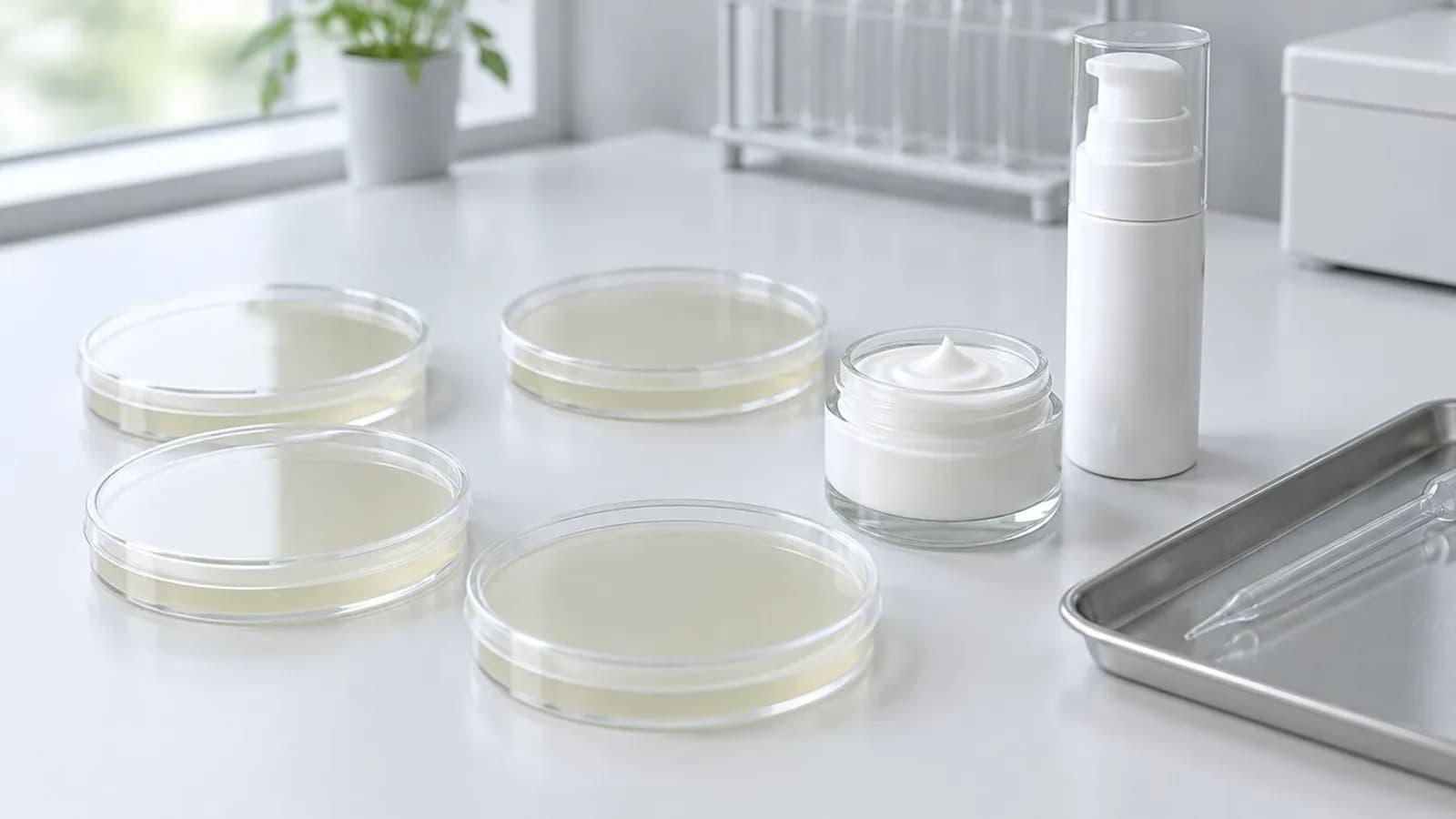
A cosmetic preservative system is chosen from the product: water, pH, nutrient-rich extracts, the pack and the way customers use it set how much protection a formula needs. A challenge test in the final pack shows whether the system works. Which preservatives it may contain is set market by market; Korea and the EU both keep closed preservative lists.
This article is for brand owners who are briefing a new skincare product, or who have been asked by a lab to choose between a lighter and a stronger system. It does not rank preservatives or quote concentrations. Preservative rules are amended over time, and whether an ingredient suits a product depends on the formula, the pack and the markets it will be sold in.
What Sets the Preservation Load of a Formula?
The preservation load is set by two things: how easily microorganisms can grow in the formula, and how often they get the chance to enter it. A formulator reads both from the brief before choosing a system, which is why the same preservative can be ample in one product and too weak in the next.
| Factor | Raises the load when | Lowers the load when |
|---|---|---|
| Water content | The formula is mostly water, as in toners, essences and gel creams | There is little or no free water, as in oils and balms |
| Water availability | Water is free to support growth | Humectants and other ingredients bind much of the water |
| pH | The pH sits in the range where the chosen system works least well | The pH suits the system the formulator chose |
| Nutrients | Plant extracts, sugars, proteins and some natural thickeners give organisms something to feed on | The formula carries few ingredients that feed growth |
| Emulsion type | Water is the outer phase | Water is held inside an oil phase |
| Use and shelf life | Fingers, wet hands and a long period after opening | Single use, or a short period after opening |
Two things surprise brand owners. The first is nutrients, from the table above. A formula built around botanical extracts or fermented ingredients can be harder to preserve than a plain one, because those ingredients feed the organisms the system is trying to stop. That is not a reason to drop them. It is a reason to tell the lab about them at the start.
The second is not in the table: raw materials. Some ingredients arrive from the supplier already containing a preservative or a carrier, and that carryover counts toward the finished product. It matters for the system itself and for any free-from claim, which is why each raw material's specification should be in the development file. How to brief a Korean formulation lab shows where to list exclusions so the lab can check carryover from the first round.
How Does Packaging Change the System?
Packaging changes the system because it decides how much air, water and skin reach the product during use. A pack that lets in less gives the formula less to defend against, so the same formula can need a different system in a different pack.
| Pack | What reaches the product during use | What that means for the system |
|---|---|---|
| Open jar | Air across a wide surface, fingers, sometimes water | Highest demand among common packs |
| Dropper bottle | Air on every use, a pipette that has touched skin returns to the bottle | High demand |
| Tube | Limited air, no finger contact with the contents | Low to moderate demand |
| Airless pump | Very little air, no return flow | Lowest demand among multi-use packs |
| Single-dose ampoule or sachet | Nothing until it is opened and used | Lowest demand overall |
The order in the table ranks exposure only; it does not say which pack is better. Each pack has costs in unit price, sensory feel and how the product reads on the shelf, and those trade-offs are set out in airless pump vs dropper packaging for serums. A serum often moves between droppers and airless pumps during development, and a cream between jars and tubes, so the pack question usually comes up for both; see serum and ampoule development and cream and moisturiser development.
What matters for preservation is the order of decisions. A lighter system in an airless pump still has to pass a challenge test in that pump. If the pack later changes to a jar, the system that passed may not be enough, and the test has to be repeated in the jar. Choosing the pack before the formula is frozen avoids that loop.
What Does a Challenge Test Actually Show?
A challenge test shows whether the preservative system in one formula, in one pack, reduces, over a defined period, microorganisms that are deliberately added to it. It is the standard way to show that a water-containing product is adequately preserved, and its report belongs in the safety documentation kept for the product.
The international reference is ISO 11930:2019, amended in 2022. It sets out how to interpret the results of a preservation efficacy test, a microbiological risk assessment, or both, when evaluating a cosmetic's overall antimicrobial protection. The efficacy test it describes is the reference method for assessing how a formula is preserved. The standard is written mainly for water-soluble and water-miscible products and can be adapted for products in which water is the inner phase. It does not apply to products that ISO 29621 and its Annex A identify as low microbiological risk. The standard can also serve as guidance on method during product development.
What a passing result does and does not tell you:
- It covers the formula as tested. Changing the preservative, the water phase, the pH or a nutrient-rich ingredient means the result no longer describes the product.
- It covers the pack as tested. The test runs in the final pack, which is why the pack has to exist before the test can start.
- It is separate from stability. Stability testing asks whether the product stays physically and chemically intact. A challenge test asks whether it resists contamination. How stability testing works explains why the two run side by side and are still reported separately.
- It is not batch release. Whether a given production batch is microbiologically clean is answered by inspecting that batch against the agreed specification. The quality and testing service describes how challenge testing is coordinated before production and how finished goods are inspected against that specification.
What "Preservative-Free" Usually Means in Practice
A preservative-free product still has to resist contamination, so something else is doing the work. In practice that is one of three things, or a combination, and each one changes the formula or the pack.
Ingredients classed under another function. Some ingredients have an antimicrobial effect but are in the formula for another purpose, such as moisturising or fragrance, and are not classified as preservatives under a market's rules. Whether that classification holds, and how a free-from claim built on it is read, differs by market.
Less available water. Anhydrous products such as oils and balms, and formulas in which most of the water is bound, give organisms little to grow in.
The pack. Single-dose formats and airless pumps cut the exposure that a preservative would otherwise have to handle.
None of these removes the need to show the product is adequately protected. The usual costs are a different pack, a shorter period after opening, or a system that is harder to formulate around. That makes "preservative-free" a formulation constraint to raise in the brief, not a label decision to make at artwork. How free-from claims are read in different markets, and what they commit you to, is covered in clean beauty claims for brand owners.
Why the Same System May Not Travel
The same preservative system may not travel because the rules on preservatives are set market by market. Korea and the EU both work on a closed list: only preservatives on the list may be used for that purpose, within the limits and conditions set there. The two lists are separate documents, so a system built for one can need a different ingredient or a different level for the other.
| Market | Where the list sits | The principle |
|---|---|---|
| Korea | Cosmetics Act, Article 8, and MFDS's Regulation on Safety Standards, etc. for Cosmetics, Article 4 and Annex 2 (ingredients that require restrictions on use, with their use standards) | MFDS designates use standards for ingredients such as preservatives, colourants and UV filters, and an ingredient not designated cannot be used for that purpose |
| European Union | Regulation (EC) No 1223/2009, Annex V | Only substances listed in Annex V may be used as preservatives, within the maximum concentrations and conditions set there |
The Korean list sits in an MFDS notice and Annex V in an EU regulation, and both are amended from time to time. A system checked against either list during development is worth checking again before each new market or reformulation.
This article covers only Korea and the EU; for any other market, the rules that apply there need checking separately. The practical rule is the same everywhere: name every market in the brief before development starts. A system that has to fit Korea and the EU from the first round is chosen against both lists. A system changed after stability and challenge testing means repeating both, because the tests describe the formula that was tested.
For the EU route as a whole, from the annex check to notification, see CPNP notification for a Korean-made cosmetic and our European Union market page.
How to Brief the Preservative Question
A useful brief gives the formulator what sets the load, rather than a preservative to use. Four lines cover most of it:
- Markets. Every country or region where the product will be sold, including the ones planned for later.
- Pack. The intended pack, or the two packs still under consideration.
- Exclusions and claims. Any ingredient you want to exclude and any free-from claim you plan to make, so carryover can be checked.
- Use. Period after opening, and whether the product will be used with wet hands, as in a shower or bath.
When we coordinate development, this information goes to the formulator at our Korean partner manufacturer before the base is chosen, and the challenge test is planned in the final pack. Our formulation service describes how that development work is scoped.
Frequently Asked Questions
Which preservative should my serum use?
That depends on the serum's water content, pH, nutrient-rich ingredients, pack and target markets, so there is no single answer to give in advance. The formulator chooses preservatives allowed in each of your markets, such as those on Korea's and the EU's lists, and the challenge test in the final pack shows whether the choice works.
Asking for a specific preservative by name narrows the options before those facts are known. It is usually better to state the constraints and let the lab propose the system.
Does every skincare product need a challenge test?
Not every one. For a water-containing product, a challenge test is the standard way to show the preservative system works, but ISO 11930 does not apply to products identified as low microbiological risk under ISO 29621, which is why some anhydrous products follow a different route.
Whether a specific product qualifies as low risk is assessed on that product; its category alone does not settle it.
Can I call my product preservative-free?
Possibly, but something still has to protect the product, and how the claim is read differs by market. Usually that protection comes from ingredients classed under another function, low water availability or a protective pack, and the product is still tested.
Plan the claim in the brief, because it shapes the formula and the pack. The clean beauty claims guide covers the free-from rules that most often catch brands.
Can one preservative system work for both Korea and the EU?
It can, if every preservative in it is on both lists and used within both sets of conditions. The check is made against each list before development starts, because a change after testing means testing again.
Korea's list sits in an MFDS notice under the Cosmetics Act, and the EU's in Annex V of Regulation (EC) No 1223/2009. Both are amended over time.
Why does changing from a tube to a jar mean retesting?
Changing the pack means retesting because a challenge test describes the product in the pack it was tested in. A jar is opened and touched daily, so it asks more of the system than a tube does, and a system that passed in the tube may not pass in the jar.
Changing the pack after testing usually means repeating both the challenge test and stability testing.
Do botanical extracts make a formula harder to preserve?
Often, yes. Extracts, sugars and other nutrient-rich ingredients can feed microorganisms, which raises the load on the system. They can still be used, provided the lab knows about them from the first round and chooses the system with them in the formula.
- ISO 11930:2019 Cosmetics — Microbiology — Evaluation of the antimicrobial protection of a cosmetic product — International Organization for Standardization (ISO)
- Regulation (EC) No 1223/2009 on cosmetic products — EUR-Lex, European Union
- Regulation on Safety Standards, etc. for Cosmetics (화장품 안전기준 등에 관한 규정), MFDS Notice — Ministry of Government Legislation (Korea Law Information Center)
- Cosmetics Act (화장품법) — Ministry of Government Legislation (Korea Law Information Center)
This page is general information for manufacturing planning. It is not legal or regulatory advice, it has no legal effect, and no rights can be derived from it. Requirements change by market and over time — before acting on anything here, confirm the current position with the authority concerned or with qualified counsel.