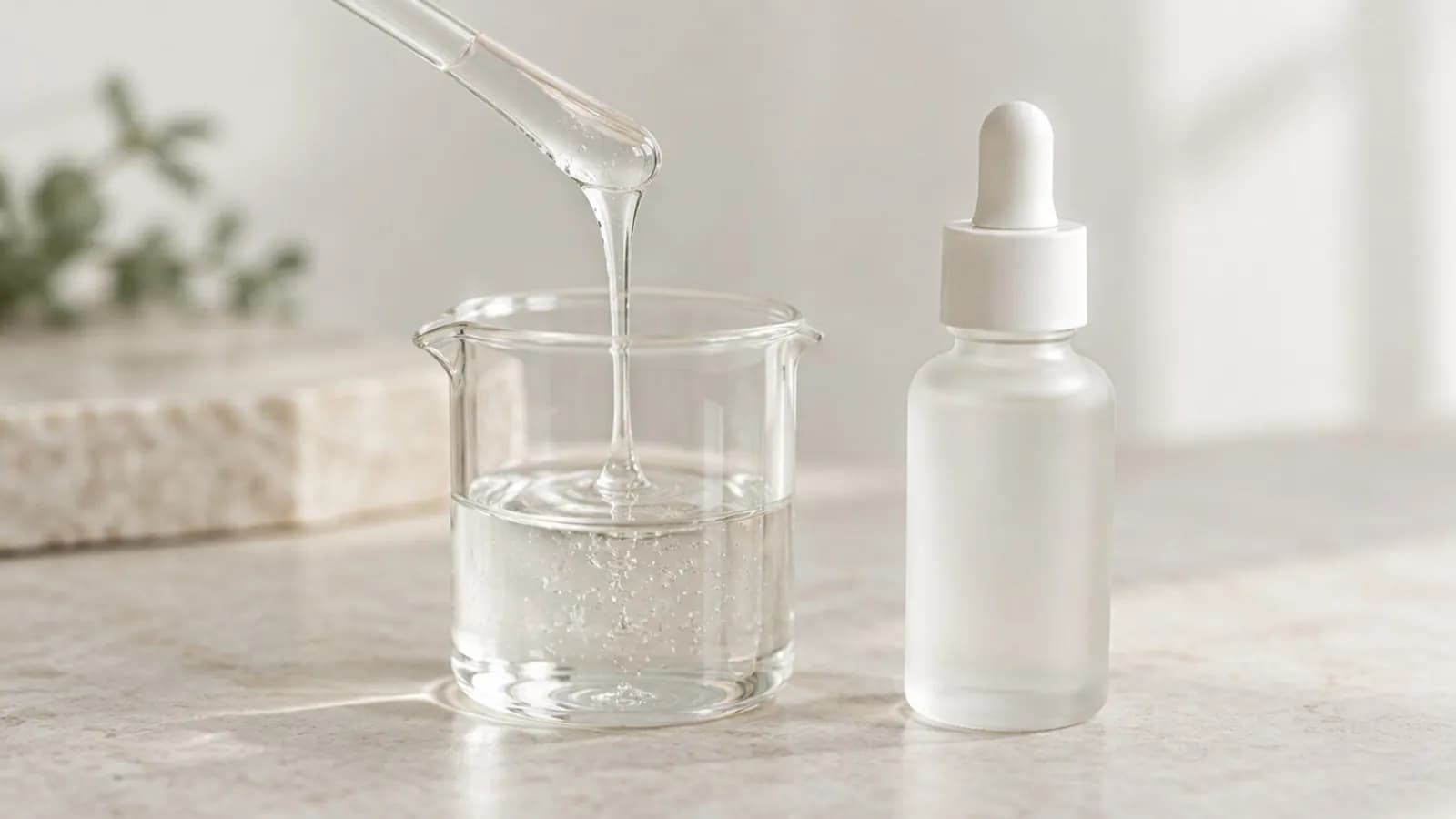
A snail mucin essence is among the quickest K-beauty launches. Korean partner manufacturers we work with hold snail essence base formulas, so a project can start as private label on an existing base, or be developed further from that base as a snail mucin essence ODM project. What shapes the product is the raw material behind the INCI name, the pack and the claim.
What Is Snail Mucin?
Snail mucin is the secretion snails produce, collected and filtered into a cosmetic raw material. On an ingredient list it appears under its INCI name, Snail Secretion Filtrate, which is the name used in the European Commission's CosIng database and the one your label will carry whatever the marketing copy calls it.
The material is usually described as a mix of glycoproteins, polysaccharides and other naturally occurring components in water. In the bottle it gives a slippery, slightly stringy texture that consumers have learned to recognise, and that texture is a large part of why the category sells.
The important point for a brand is that one INCI name covers many different raw materials. Suppliers differ in the snail species, how the secretion is collected, how it is filtered and concentrated, and what is added to keep the material stable before it reaches the factory. Two products that both declare Snail Secretion Filtrate can contain materials that look, smell and behave differently. The INCI name tells you what kind of ingredient is present. It does not tell you which one.
That is why we ask for the raw material specification and the supplier's traceability documents before a formulation route is chosen. The specification shows what the supplied material contains besides the filtrate. The traceability documents show where it came from and how it was processed, which you will need later if a retailer, a certifier or a regulator asks.
Why Brands Are Developing Snail Mucin Products
Snail mucin is one of the ingredients overseas shoppers associate most directly with Korean skincare. Many buyers already know the name, the texture and the format, so a new brand is not paying to explain the ingredient. That recognition is also the commercial problem: many K-beauty ranges already include a snail essence, and the ingredient alone does not set a product apart.
The briefs we receive tend to follow three patterns:
- A hero essence. The snail essence is the first product, and the brand builds the range around its texture.
- A supporting ingredient across a range. Snail filtrate appears in a cream, a sheet mask and an essence, carrying a consistent story without being the headline everywhere.
- A pairing story. Snail mucin combined with soothing or barrier ingredients, such as centella or ceramides, so that the formula has a second reason to exist.
Differentiation usually comes from the supporting ingredients, the texture, the pack and the way the claim is written, rather than from the snail filtrate itself.
Product Formats We Can Develop
Snail filtrate is water-based and works in most formats with a water phase:
- Essences are the format the category is known for: a viscous, slippery liquid with snail filtrate as the main component.
- Serums and ampoules carry snail filtrate alongside other actives, usually in a lighter texture than a classic essence. Essences, serums and ampoules are covered together under Korean serum and ampoule manufacturing.
- Creams and gel creams use it in the water phase, often paired with barrier ingredients. See moisturiser and cream development in Korea.
- Sheet masks use a snail essence as the liquid the sheet carries. See Korean sheet mask manufacturing.
- Anhydrous balms and oils are a poor fit. With no water phase, the material has nowhere to sit, and the texture that sells the category is lost.
Toners and other formats in the wider range are covered under Korean skincare manufacturing.
Developing a Snail Mucin Product: ODM, OEM or Private Label?
For most first snail products, private label is the sensible start.
Private Label
Launch on a partner manufacturer's existing snail essence base with your own pack and brand. Ask what raw material the base uses and what documentation comes with it.
ODM
The route when the supporting ingredients, the texture or the claim set is your differentiator, or when you want to develop further from an existing base rather than use it as it is.
OEM
For brands that already own a snail formula and are moving it into Korean production. It works best when the raw material is specified by supplier, not only by INCI name.
Private label works here because the formulation problem is well understood, bases already exist with partner manufacturers, and the category rewards a texture that works more than a formula that is new. The base is not yours and not unique to you, which is the trade for speed. Who owns what at the end is set by the contract, not by the route name.
ODM development makes sense when the base is a starting point rather than the answer: a different supporting complex, a lighter or richer texture, a fragrance-free version, or a claim set written for a specific market. A project can begin on a partner manufacturer's base and be developed further from it, which can keep the early rounds shorter than starting from a blank sheet. The scope of that development, and what you hold at the end, is agreed in the contract before work starts.
OEM production is the least common route for a first snail product, because few new brands arrive owning a formula. The comparison of OEM, ODM and private label sets out the general trade-offs.
What Does "96% Snail Mucin" Actually Mean?
A front-of-pack figure on a snail essence usually describes how much of the formula is the snail raw material as supplied. It does not describe how much pure secretion is in the bottle.
The supplied raw material is already a filtered, processed material with its own composition, set by the supplier's process. A high figure tells you the formula is mostly that material. The figure says nothing about how concentrated that material was to begin with, so two products printing similar figures can differ a great deal in what they actually contain.
Three consequences follow for a brand:
- The figure is a specification. If you print it, every batch has to meet it, and the formulation record and the artwork have to agree.
- The figure ties you to the raw material. Changing supplier later can change the product even when the printed figure stays the same, and changing the figure means new artwork.
- The figure is a claim. In markets that expect claims to be substantiated, a printed percentage is something your product file has to stand behind.
A brand that wants to print a figure should decide it with the raw material specification in hand, before artwork, and should be ready to explain what it measures if a buyer asks.
Formulation Considerations
Raw material variability. Snail filtrate is a natural material, and batches from the same supplier can differ in colour, odour and viscosity. Agree the acceptance range for the raw material with the manufacturer, and keep the same supplier through scale-up unless a change is deliberate and tested.
Preservation. A high-water formula built on a material rich in proteins and sugars gives microbes something to feed on. The preservative system has to be designed for that and confirmed by challenge testing in the final pack, which is a separate test from stability. See cosmetic stability testing explained for how the two differ.
Texture and viscosity. The slippery, stringy feel is part of the product. Other ingredients can change it: some thickeners make the essence heavier and less fluid, and some salts or actives can thin it. Decide the target texture early and treat it as part of the specification.
Compatibility. Snail filtrate sits comfortably with humectants, panthenol, centella derivatives and ceramides, which is why it often appears in soothing and barrier ranges. See centella and cica line development and ceramide barrier cream development.
Fragrance and colour. The raw material can carry a faint natural odour and tint. A brand that wants a fragrance-free, water-clear essence should say so in the brief, because it affects which raw material is chosen.
We work from four inputs in formulation development: the target texture, the raw material route, the claim intent and the destination market. See how to brief a Korean formulation lab for what a complete brief contains.
Packaging Considerations
Viscosity decides the pack more than anything else in this category. A thick, stringy liquid does not dispense the way a watery serum does.
- Pump bottles suit most snail essences. Check the pump against the actual viscosity of the formula, because a pump that suits a light serum may dispense a thick essence slowly or leave a string at the nozzle.
- Airless pumps reduce air and finger contact, which helps a high-water formula. Very thick textures can stall some mechanisms, so test the specific design. The trade-offs are set out in airless pump versus dropper packaging.
- Dropper bottles can suit a more fluid essence, depending on the viscosity. With a thick, stringy texture they are often awkward: the essence draws up slowly and trails from the pipette. They also reintroduce air and contact at every use.
- Tubes work well for gel creams and thicker textures and keep contact low.
- Jars suit creams but carry the highest preservation burden, because the product is opened and touched repeatedly.
Viscosity also affects filling. A texture that fills cleanly on one line can thread or trap air on another, so the pack and the filling line should be confirmed together. Components are qualified alongside the formula through Korean cosmetic packaging sourcing.
Claims and Regulatory Notes by Market
Snail mucin is an animal-derived ingredient, and that settles two questions before the wording is written. This section is orientation, not a compliance opinion.
Vegan. A product containing snail filtrate cannot be called vegan. Vegan certification schemes generally do not accept animal-derived ingredients, so a brand with a vegan range has to keep its snail product outside that claim, or leave snail out of the range. The wider rules are covered in what clean beauty claims mean and what they cost.
Sourcing and religious certification. If you intend to say anything about how the secretion was collected, or to seek a certification that depends on the source, such as halal, the supplier's documentation has to support it. Raise it in the brief and check with the certifier before the raw material is chosen. See halal certification for a Korean-made cosmetic for how that process works.
What to claim. The safe register for a snail product is cosmetic: hydration, comfort, a smoother look to skin texture, a healthy-looking glow. Wording about repairing or regenerating skin, healing wounds or fading scars describes a treatment, and treatment language can move a product out of the cosmetic category.
United States. Classification turns on intended use, which the FDA judges from the claims made on the label, in advertising and elsewhere: a product intended to affect the structure or function of the body is a drug even if it is sold as a cosmetic. The FDA's page on whether a product is a cosmetic, a drug, or both explains how intended use is established.
European Union. Regulation (EC) No 1223/2009 governs cosmetics: the product information file has to hold proof of the effect claimed where the nature or effect of the product justifies it, and the labelling must not attribute characteristics or functions the product does not have. A printed percentage counts as a claim.
Korea. A snail essence makes ordinary cosmetic claims in Korea. Korea's functional cosmetic designation covers a defined set of functions and goes through its own review or report, and the functional claim belongs to the listed active behind it, not to the snail filtrate.
MOQ and Development Timeline
We do not publish a single minimum order figure for snail projects, because the snail filtrate is rarely what sets the minimum. What usually does:
- Format and fill volume. An essence, a cream and a sheet mask have different economics at the same batch size.
- Packaging. Stock components order in smaller quantities than custom tooling or decoration, and the component minimum often exceeds the fill minimum.
- Route. Launching on an existing base usually needs less development than building a new formula, and the base may already have a production history.
- Raw material. A specified supplier with its own minimum, or a second specialty ingredient, can set the floor.
- Markets. If two destinations read your claim differently, they may need separate artwork.
How cosmetic MOQ is actually determined sets out the factors that set a minimum and what to change if the first quote comes back above your budget.
On timeline, a private label snail essence is among the more predictable projects, because the base already exists. Development further from a base adds sampling rounds: two or three with a precise brief, around six with a vague one, as described in how the sampling process works. Stability and challenge testing are the fixed block in every route and cannot be shortened by paying more.
Frequently Asked Questions
Can a snail mucin product be labelled vegan?
No. Snail secretion filtrate is an animal-derived ingredient, and vegan certification schemes generally exclude animal-derived ingredients. A brand with a vegan line keeps the snail product as a separate, non-vegan item.
How do I know where the snail mucin in my product comes from?
Ask for the raw material specification and the supplier's traceability documents before the formulation route is chosen. The same INCI name, Snail Secretion Filtrate, covers materials from different suppliers and processes.
Those documents are what you will need if a retailer, certifier or regulator asks about the source, so they belong in the project file from the start.
Can I start with private label for a snail essence?
Yes. Launching on an existing base with your own pack and brand is usually the quickest route for a first snail essence. The trade is that the base is not exclusive to you. Before you commit, ask which raw material it uses and what documentation comes with it.
What can I claim for a snail mucin product?
Stay in the cosmetic register: hydration, comfort, smoother-looking texture and glow. Avoid wording about repair, regeneration, wound healing or scars, which describes a treatment rather than a cosmetic effect.
Agree the claim set per market before the artwork is finalised, because changing it afterwards means reprinting components.
What packaging works best for a snail essence?
A pump bottle checked against the formula's viscosity suits most snail essences. Airless pumps help with a high-water formula but can stall with very thick textures. Droppers can suit a more fluid essence but are often awkward with a stringy one. Confirm the pack and the filling line together.
Does a high snail mucin percentage on the front of the pack mean a stronger product?
Not necessarily. The figure usually describes how much of the formula is the snail raw material as supplied, and raw materials differ in how they are processed and concentrated. Two products printing similar figures can contain quite different materials.
- CosIng — Cosmetic Ingredient Database — European Commission
- Regulation (EC) No 1223/2009 on cosmetic products — EUR-Lex, European Union
- Is It a Cosmetic, a Drug, or Both? (Or Is It Soap?) — U.S. Food and Drug Administration
- Cosmetic Regulatory Framework in Korea — Ministry of Food and Drug Safety, Republic of Korea
This page is general information for manufacturing planning. It is not legal or regulatory advice, it has no legal effect, and no rights can be derived from it. Requirements change by market and over time — before acting on anything here, confirm the current position with the authority concerned or with qualified counsel.