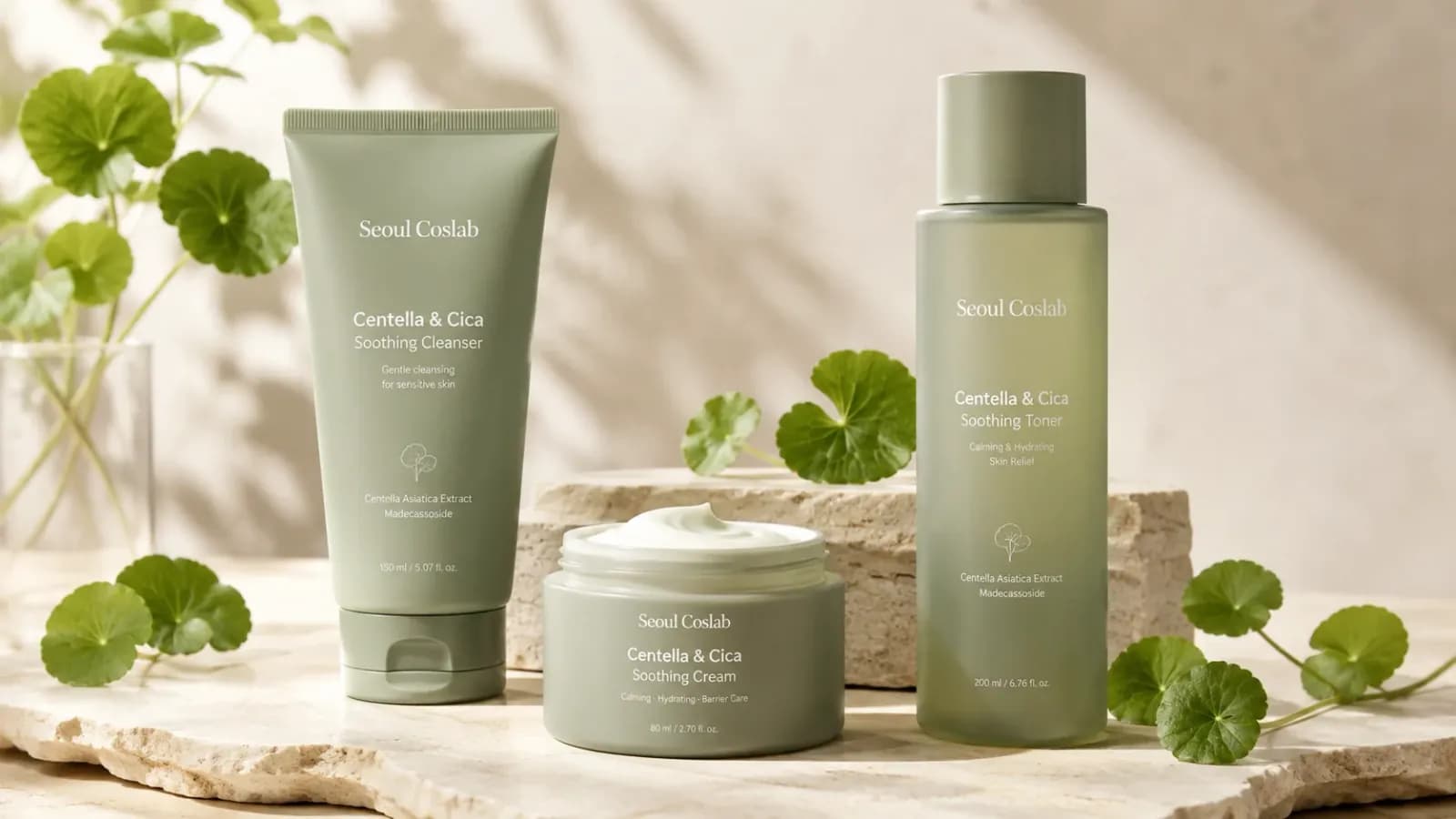
Centella is the ingredient most associated with K-beauty abroad, and the one where two products carrying the same name on the front of the pack can differ most in what is actually inside. The INCI declaration is identical whether the extract was standardised to a defined active content or simply macerated from leaves. That is the whole story of this ingredient, commercially speaking.
What Is Centella Asiatica?
Centella asiatica is a creeping herb used for centuries in traditional medicine across Asia. In cosmetics it is used as an extract, and four constituents do most of the work:
- Madecassoside and asiaticoside — the glycosides, most associated with soothing positioning
- Madecassic acid and asiatic acid — the triterpene acids
Together these four are often referred to as the titrated or standardised fraction, and premium raw materials state the content of each. Commodity extracts do not.
On an ingredient list you will see something like Centella Asiatica Extract or Centella Asiatica Leaf Extract, and increasingly the isolated actives declared separately — Madecassoside, Asiaticoside. Because the extract INCI name is the same regardless of quality, the specification is the only thing that tells you what you have bought. A brand paying a premium for a cica product should be able to state the standardisation, and a brand that cannot probably is not getting one.
"Cica" is a marketing abbreviation, not a regulated term. It carries no requirement about content.
Why Brands Are Developing Centella Products
Centella occupies a rare position: high global consumer recognition, strong association with Korean manufacturing specifically, and a soothing benefit that consumers can feel. It is one of the few ingredients where "made in Korea" is itself a credibility signal to the end customer.
Where we see it used:
- Sensitive and reactive skin lines. The anchor use, and the one with the most durable demand.
- Post-procedure and post-sun ranges. Popular in clinic and professional channels, and the place where claim discipline matters most.
- Blemish-adjacent positioning. Widespread and the highest-risk claim territory — see the market notes below.
- Barrier and soothing combinations. Pairs naturally with ceramides; see ceramide barrier cream development.
The commercial catch is saturation. Cica products are everywhere at every price point, so a brand entering the category needs either a standardisation story it can substantiate or a format the category has not filled.
Product Formats We Can Develop
Centella extracts are typically water- or glycol-soluble and tolerate a wide formulation range, which makes this one of the most format-flexible ingredients on the site.
- Creams and soothing balms — the category default. See moisturiser and cream development in Korea.
- Sheet masks — an extremely strong fit. High water content, a soothing benefit consumers feel during use, and the export format K-beauty is best known for. See Korean sheet mask manufacturing.
- Serums and ampoules — straightforward, and the format where isolated madecassoside is most often used. See Korean serum and ampoule manufacturing.
- Toners and toner pads — high volume, popular, and forgiving of the extract's colour.
- Cleansers — workable, though contact time limits what the active contributes.
- Body and after-sun formats — under-used and commercially interesting.
Developing a Centella Product: ODM, OEM or Private Label?
Private Label
Abundant bases at every price tier. The fastest route, and the one where you most need to ask what standardisation the base actually uses.
ODM
The route when your story is the extract quality, a specific standardised fraction, or a matched range with one sensory signature.
OEM
For brands transferring an existing formula. Straightforward, provided the extract supplier and specification are documented.
Because private label bases are so widely available, the meaningful question for centella is not which route but what is in the base you are being offered. Ask for the extract specification and the standardised content before you commit. Two private label cica creams at different prices are usually different products, and the difference is not always visible on the INCI list.
Centella ODM development in Korea is worth the cost when the extract itself is your positioning — a stated madecassoside content, a specific titrated fraction, a named origin — or when you want a matched range where the toner, serum and cream share one sensory signature. In a saturated category, a substantiated specification is one of the few durable differentiators left.
Whichever route you take, our cosmetic quality control in Korea process verifies incoming extract against specification rather than against the supplier's word, which for this ingredient is not a formality.
Formulation Considerations
Standardisation is the first decision. Fix the extract and its specification before anything else. Everything downstream — colour, odour, cost, claim, stability — follows from it. Changing extract late means repeating the work.
Colour. Centella extracts run yellow-green to brown, and at meaningful use levels they tint the product. This is not a defect and many brands use it as a visual cue, but it must be a decision. If the brief calls for a white cream, either the use level or the extract grade has to change. Colour also drifts over shelf life, which needs to be specified as acceptable rather than discovered as a complaint.
Odour. Plant extracts carry a characteristic herbal note that becomes more assertive at higher use levels. Masking it in a fragrance-free product — which sensitive-skin positioning usually requires — is real formulation work.
pH and stability. The extract is comfortable across a mildly acidic to neutral range. The glycosides are reasonably robust; prolonged heat during manufacture is the main risk, so cool-phase addition is standard.
Extract versus isolate. Isolated madecassoside gives precise control, no colour and no odour, at a much higher cost per unit of active — and it loses the "botanical extract" story some brands are buying. Whole extract gives the story, the colour and the odour. Many good formulas use both.
Compatibility. Centella sits well with ceramides, panthenol, peptides, niacinamide and most humectants. Combining it with high concentrations of exfoliating acids works against the soothing positioning even where it is technically stable.
Send the colour and odour tolerances as part of the brief — see how to brief a Korean formulation lab. Our formulation development service asks about them in round one because they are the two things clients most often react to in round two.
Packaging Considerations
- Tubes — the practical default for creams. Good protection, no finger contact, cost-efficient.
- Jars — expected in the premium soothing segment, but repeated open contact raises the preservation requirement.
- Airless pumps — the best protection for a lightly tinted formula, since limiting oxygen exposure also limits colour drift.
- Sachets for masks — a barrier laminate is required; a single-layer film will not hold a high-water essence over shelf life.
- Wide-mouth jars for pads — high-volume, popular, and a repeated-contact format that has to be preserved for it.
Clear or translucent components display the extract's colour honestly, which some brands want and others do not. Decide before tooling. Components are qualified alongside the formula through Korean cosmetic packaging sourcing.
Claims and Regulatory Notes by Market
Centella is where traditional-medicine heritage and cosmetic claim rules collide most directly. Orientation only — not a compliance opinion.
United States. Soothing, comforting and moisturising claims are conventional cosmetic claims. The line is treatment language: healing wounds, treating acne, treating dermatitis or eczema are drug claims under the FD&C Act, and centella's traditional reputation makes this the ingredient where brands most often drift across. Acne in particular is a US over-the-counter drug category with its own monograph requirements — an anti-acne claim is not a cosmetic claim. MoCRA registration, listing and safety substantiation obligations apply to imported product.
European Union. Regulation (EC) No 1223/2009 governs, with INCI declaration, a Product Information File, safety assessment, an EU Responsible Person and CPNP notification. Claims must meet the common criteria. Botanical claims attract particular attention: traditional use is not itself evidential support, and the claim must be about the finished product rather than about the plant's history.
Korea. Under the Cosmetics Act, soothing and moisturising are general cosmetic claims and do not fall within the defined functional cosmetics categories. A centella product is a general cosmetic unless it also contains a listed functional active — which many Korean cica products do, pairing centella with an active such as niacinamide for a brightening functional claim.
MOQ and Development Timeline
We do not publish minimum order figures. On centella projects the drivers are:
- Extract grade. A high-standardisation titrated extract or isolated madecassoside costs an order of magnitude more than a commodity extract, and can set the project floor on its own.
- Format. Sheet masks, creams and toner pads have very different minimums for equivalent revenue.
- Packaging. Stock components order far smaller than custom tooling.
- Range breadth. A matched cica range spreads development cost across SKUs but raises the total first order.
- Route. Private label from an existing base starts lower than ODM development.
How cosmetic MOQ is actually determined explains how these interact. On timeline, centella formulations develop faster than most — the extract is well characterised and the systems are conventional — with the variable time going into colour and odour rather than into stability.
Frequently Asked Questions
What is the difference between centella and cica?
None chemically. "Cica" is a marketing abbreviation used across the category; Centella asiatica is the plant. Because cica is not a regulated term, it carries no requirement about extract content or standardisation. That is exactly why the extract specification, not the name on the pack, is what you should be comparing.
Should I use whole extract or isolated madecassoside?
Whole extract gives you the botanical story along with colour and a herbal odour. Isolated madecassoside gives precise control and neither of those, at a much higher cost per unit of active. Many good formulas use both — the isolate for the substantiated level, the extract for the story. Decide before development, because it affects colour, odour and cost together.
Why is my cica cream green, and will it stay that way?
Centella extracts are naturally yellow-green to brown and tint the product at meaningful use levels. The colour also drifts over shelf life. Neither is a defect, but both need to be specified as acceptable at the brief stage. If a white cream is essential, the use level or the extract grade has to change.
Can I claim my centella product treats acne or heals skin?
Not as a cosmetic. Acne treatment is a drug claim in the US with its own regulatory pathway, and wound-healing language is a drug claim in both the US and the EU. Soothing, comforting and moisturising language is the cosmetic register for this ingredient, and there is enough of it to build a strong product story.
Is private label a good route for a cica product?
It is efficient, but this is the ingredient where you most need to interrogate the base. Ask which extract, at what standardisation, at what level. Two private label cica creams at different prices are usually different products, and the INCI list will not always show you where the difference is.
- Is It a Cosmetic, a Drug, or Both? (Or Is It Soap?) — U.S. Food and Drug Administration
- CosIng — Cosmetic Ingredient Database — European Commission
- Cosmetic Regulatory Framework in Korea — Ministry of Food and Drug Safety, Republic of Korea
This page is general information for manufacturing planning. It is not legal or regulatory advice, it has no legal effect, and no rights can be derived from it. Requirements change by market and over time — before acting on anything here, confirm the current position with the authority concerned or with qualified counsel.